

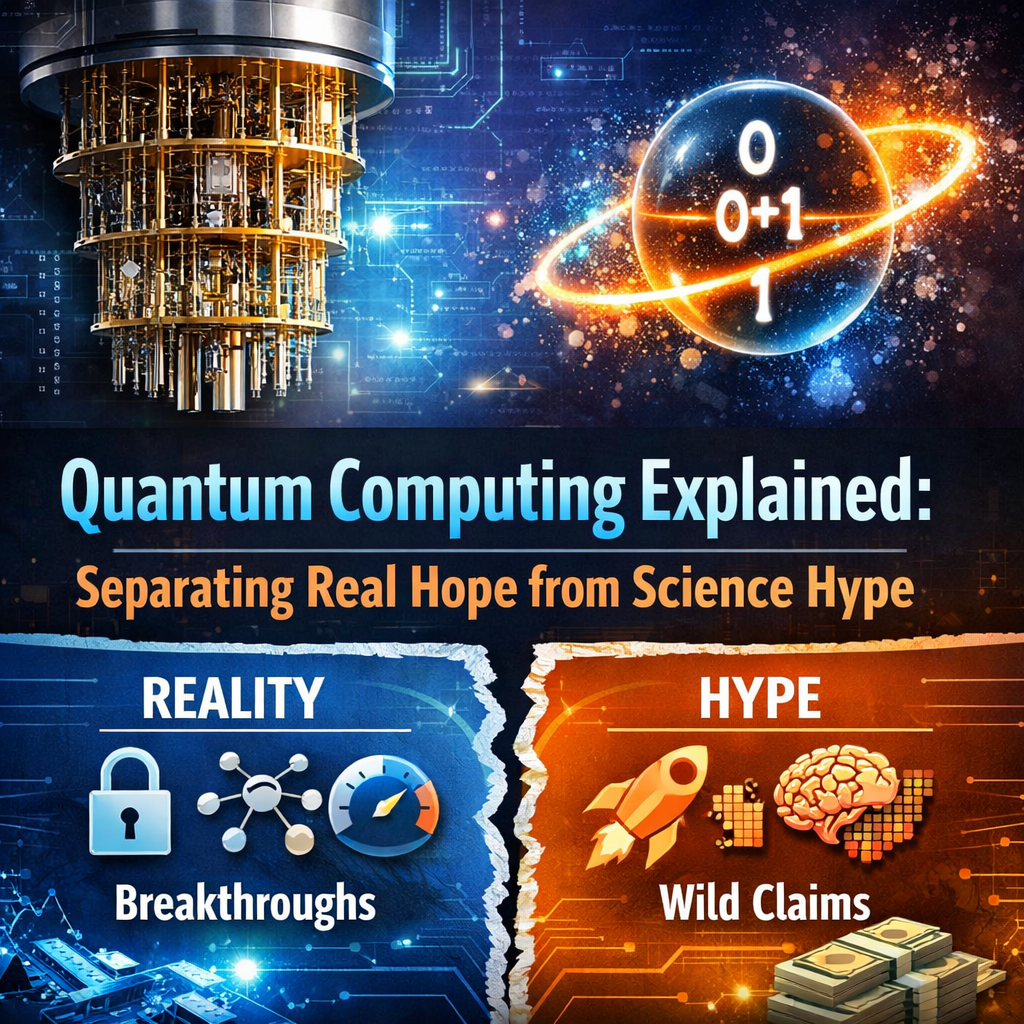
You’ve seen the headlines. “Quantum Computer Breaks Encryption!” “Quantum Supremacy Achieved!” “This New Machine Will Solve Climate Change!” The stories flash by, a confusing mix of revolutionary promise and impenetrable jargon—qubits, superposition, entanglement. It sounds like science fiction, the exclusive domain of physicists in lab coats and tech giants with bottomless budgets. For anyone not holding a PhD in quantum mechanics, it’s easy to feel two things: a sense of awe and a pang of exclusion.
What if I told you that the core ideas of quantum computing aren’t just for scientists? That you can understand enough of its strange logic to separate the world-changing potential from the overblown hype? And that the real story isn’t just about the mind-bending physics, but about the brutally difficult, fridge-sized hardware being built in labs today?
Welcome to quantum computing for the rest of us. This isn’t a textbook. We won’t derive Schrödinger’s equation. Instead, we’re going on a guided tour of the quantum landscape, with three clear stops: the Hype (what you’re being sold), the Hope (the legitimate, breathtaking possibilities), and the Hardware (the messy, magnificent engineering making it real). By the end, you won’t be a quantum expert, but you’ll be a quantum-informed realist. You’ll know why your passwords are safe for now, what problems this technology might genuinely crack open in your lifetime, and why building a quantum computer is arguably one of the hardest engineering challenges humanity has ever undertaken. Let’s demystify the revolution, one qubit at a time.
The Hype – Cutting Through the Quantum Noise
Let’s start by calmly addressing the most sensational claims. The quantum hype cycle is powered by a fundamental misunderstanding: the belief that quantum computers are just faster versions of the laptop on your desk. This is dangerously wrong.
The “Faster Everything” Fallacy
Your classical computer thinks in bits: tiny switches that are either definitively ON (1) or OFF (0). Every app, website, and video game is built from intricate sequences of these binary choices. A quantum computer uses qubits. Thanks to the quantum principle of superposition, a qubit can be in a state that is both 1 AND 0 at the same time—like a coin spinning in mid-air. When you entangle multiple qubits, this effect multiplies. Two entangled qubits can represent 4 states simultaneously (00, 01, 10, 11), three can represent 8, and so on. This is the source of the hype: a 300-qubit computer could, in principle, hold more simultaneous states than there are atoms in the known universe.
- The Catch: You can’t just read out that vast superposition. The moment you measure a qubit, its fragile quantum state “collapses” to a single, definite answer (1 or 0). The magic lies in orchestrating the collapse so that wrong answers cancel each other out and the correct answer shines through. This means quantum computers aren’t good for everything—they’re not for spreadsheets, word processing, or browsing the web. They are exquisitely tuned for specific types of problems.
Debunking the Big Myths
- Myth 1: “Quantum Computers Will Break All Encryption Tomorrow.” This is the most common fear. It’s based on Shor’s Algorithm, a quantum program that could, in theory, crack the widely-used RSA encryption that secures the internet. The Reality: Running Shor’s Algorithm on a real-world problem (like breaking a 2048-bit RSA key) would require millions of highly stable qubits, with near-perfect error correction. We currently have machines with hundreds of noisy, error-prone qubits. Experts estimate this threat is likely 15-30 years away, giving the world ample time to deploy new, “quantum-safe” encryption algorithms (which already exist).
- Myth 2: “Quantum Supremacy Means Useful Quantum Computers.” “Quantum supremacy” or “quantum advantage” is a specific, important milestone: it’s when a quantum machine performs a single, often contrived, calculation faster than any classical supercomputer could. Google claimed this in 2019. The Reality: This is a proof-of-concept, like the Wright brothers’ first flight. It proved the machine could fly, not that it could carry passengers across the ocean. The calculation had no practical use. We are now in the era of striving for “practical quantum advantage”—solving a useful problem faster or cheaper.
- Myth 3: “It Will Instantly Solve Climate Change, Cure Cancer, etc.” Quantum computers are not oracles. They are specialized tools that could accelerate discovery in these fields. They might simulate novel catalysts for carbon capture or model complex protein folding for drug discovery far more efficiently than classical machines. But they won’t spit out “The Solution.” They will provide powerful new data points for human scientists to interpret.
The Real Signal in the Noise: The hype isn’t all wrong; it’s just premature and misdirected. The massive investment (billions from governments, IBM, Google, Microsoft, Amazon, and startups) isn’t based on fiction. It’s a long-term bet on a fundamentally new way of processing information.
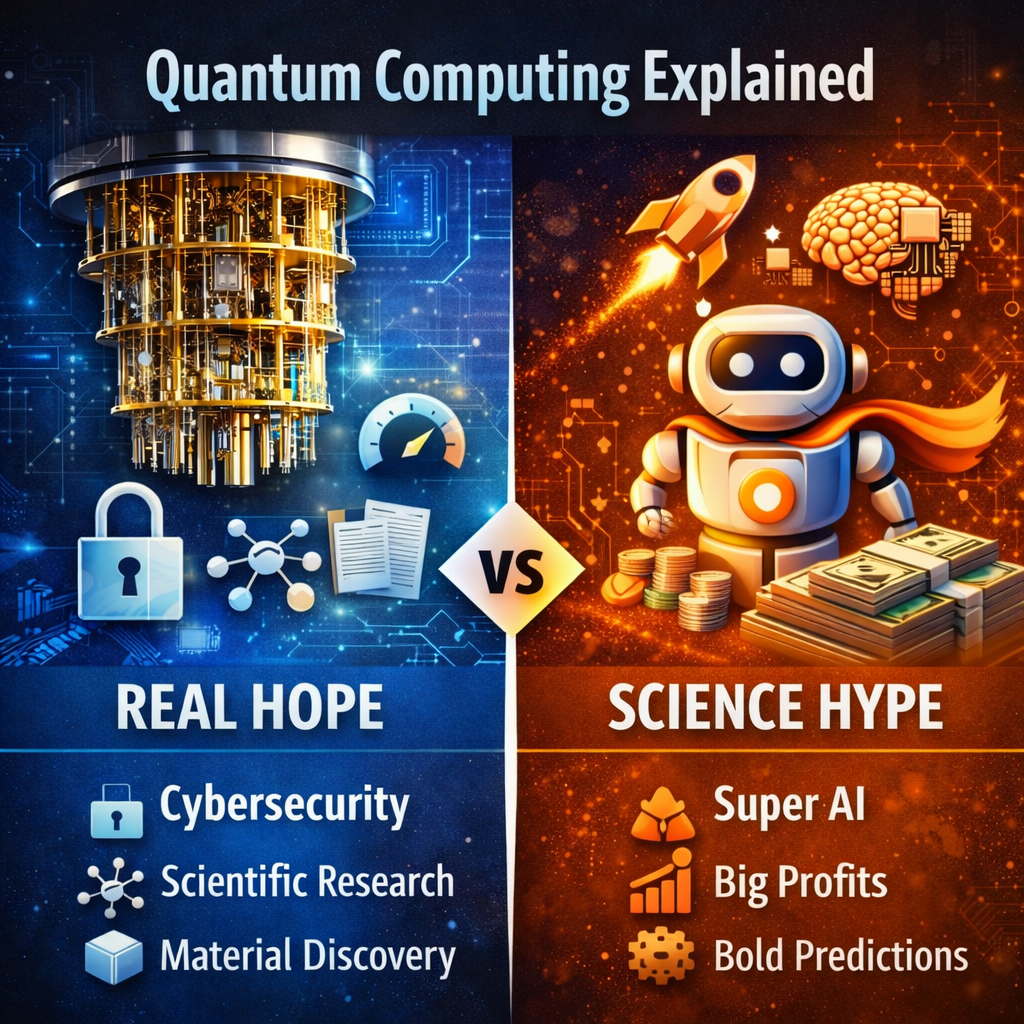
The Hope – The “Killer Apps” on the Horizon
If quantum computers are so specialized, what are they good for? Think of them as ultimate simulation machines and master optimizers. Their hope lies in tackling problems where the complexity explodes for classical computers.
1. Simulation of Nature, Atom by Atom
This is perhaps the most natural fit. The universe at its smallest scale runs on quantum mechanics. Simulating a molecule’s behavior on a classical computer is brutally hard because you have to calculate the interactions of every electron with every other electron—a computation that grows exponentially.
- Example – Fertilizer & Climate: The Haber process, which produces ammonia for fertilizer, consumes ~2% of the world’s energy. It requires extreme heat and pressure. The enzyme in pea plants (nitrogenase) does this at room temperature. A quantum computer could simulate nitrogenase with full quantum accuracy, potentially guiding us to a new, energy-efficient catalyst, saving gigatons of CO₂.
- Example – Drug Discovery: Instead of years of trial-and-error in a lab, researchers could use a quantum computer to digitally simulate how a candidate drug molecule interacts with a complex protein target, rapidly screening for efficacy and side effects.
2. Optimization: Finding the Needle in a Million-Haystack Universe
Many business and logistics problems are about finding the best solution from a staggering number of possible solutions (e.g., the most efficient route for a fleet of delivery trucks, the optimal configuration of a financial portfolio, or the best design for an airplane wing).
- How it Helps: Quantum algorithms can explore this vast “solution space” in parallel. While they won’t guarantee a perfect answer, they are exceptionally good at finding extremely good answers much faster than classical approaches for certain problem structures. Imagine finding the near-perfect global shipping route in minutes instead of days.
3. Quantum Machine Learning (QML)
This emerging field asks: can the inherent parallelism of quantum states turbocharge AI? The hope is that quantum systems could identify subtle, high-dimensional patterns in data that are invisible to classical neural networks.
- Potential Impact: This could lead to more powerful models for material science, complex system prediction (like financial markets or weather), or advanced image recognition with far less data.
(Table: Classical vs. Quantum Problem-Solving)
| Problem Type | Classical Computer Approach | Potential Quantum Advantage | Real-World Example |
|---|---|---|---|
| Molecular Simulation | Uses approximations; struggles beyond ~50 electrons. | Models the system natively as a quantum system; more accurate. | Designing new batteries or superconductors. |
| Complex Optimization | Tries solutions sequentially or with smart heuristics; can get stuck. | Explores many solution pathways simultaneously. | Managing a smart grid for a city. |
| Searching an Unstructured Database | Must check each entry one-by-one in the worst case. | Grover’s Algorithm can find the item in roughly √N steps. | Accelerating certain types of code-breaking. |
The Hardware – The Cold, Hard Reality of Building a Qubit
This is where hope meets engineering grit. Creating and maintaining a qubit is an epic battle against the universe itself. To understand the “quantum winter” some fear, you must understand the hardware challenge.
The Enemy: Decoherence and Noise
A qubit’s power—its fragile superposition—is also its greatest weakness. Any interaction with the outside world (a stray photon, a vibration, a magnetic field) causes decoherence: the qubit collapses into an ordinary, boring bit. This is the quantum version of a tiny gust of wind stopping the spinning coin. The time a qubit can maintain its quantum state is called its coherence time. Fighting to extend this time is the central engineering challenge.
The Contenders: How to Build a Qubit
Different approaches use different physical systems to create qubits, each with pros and cons. Think of these as different races to build the first reliable airplane.
- Superconducting Qubits (The Front-Runner): Used by Google, IBM, and Rigetti.
- What it is: Tiny loops of superconducting metal cooled to near absolute zero (-273°C). Current flows in them without resistance, and their quantum state is defined by the direction of the current.
- Pros: Manufactured using adapted silicon chip technology; can be controlled and linked with microwave pulses relatively quickly.
- Cons: Require massive, expensive dilution refrigerators. Coherence times are still short (microseconds to milliseconds). Scaling up requires solving immense control wiring challenges inside the fridge.
- Trapped Ions (The Precision Artist): Used by IonQ and Honeywell.
- What it is: Individual atoms (ions) are suspended in a vacuum by electromagnetic fields and manipulated with lasers.
- Pros: Very stable, with long coherence times. Qubits are identical (as all atoms of an element are). Naturally interact over distance, which is good for entanglement.
- Cons: Slower to operate. The complex trap and laser systems are harder to miniaturize and scale to thousands of qubits.
- Photonic Qubits (The Speed-of-Light Contender): Pursued by PsiQuantum and Xanadu.
- What it is: Uses particles of light (photons) as qubits, with their state encoded in properties like polarization.
- Pros: Can operate at room temperature. Photons are naturally resilient to some types of noise and travel quickly.
- Cons: Getting photons to interact (to perform logic gates) is very difficult and often inefficient, requiring complex optical setups.
- Topological Qubits (The Dark Horse): The approach Microsoft is betting heavily on.
- What it is: Relies on hypothetical quasi-particles whose quantum information is stored in their braided world-lines, making it intrinsically protected from local noise (like a knot that is hard to undo).
- Pros: In theory, this could offer built-in error correction, a huge advantage.
- Cons: The required Majorana fermion particles are extraordinarily difficult to create and prove in a lab. It’s high-risk, high-reward.
The Million-Qubit Dream and the Error Correction Bottleneck
Today’s best machines have hundreds of “physical qubits.” To run useful algorithms like Shor’s or complex simulations, we’ll likely need millions. But there’s a crucial twist: most of those millions won’t be doing the core calculation. They’ll be fixing errors.
Because physical qubits are so noisy, we use quantum error correction (QEC). The idea is to spread the information of one perfect “logical qubit” across many entangled physical qubits. If one goes bad, the others vote to correct it. Current estimates suggest you might need 1,000 or more error-prone physical qubits to create one stable logical qubit. This is the true scaling challenge: we need to build machines with hundreds of thousands of physical qubits just to get hundreds of logical ones.
The Roadmap – What to Expect (and When)
Given these hurdles, what does a realistic timeline look like? Think in eras, not years.
- The NISQ Era (Now – ~2030): Noisy Intermediate-Scale Quantum.
- Characteristics: Machines with 100s to 1,000s of physical qubits, with high error rates and no full error correction.
- What’s Possible: Exploration and refinement of algorithms, quantum chemistry simulations for small molecules, specialized optimization experiments. The goal is to find “quantum utility”—where a NISQ machine provides a measurable benefit for a niche, real-world task, even if a supercomputer could still eventually solve it.
- The Fault-Tolerant Era (~2030s+):
- Characteristics: The deployment of effective quantum error correction, leading to the first stable “logical qubits.” Machines will grow in logical power.
- What’s Possible: This is when the true “hope” applications start to become viable. Meaningful drug and material discovery, more complex optimizations. This era will likely begin with hybrid classical-quantum systems, where a quantum chip acts as an accelerator for a specific subtask.
- The At-Scale Era (2040s+):
- Characteristics: Machines with thousands of logical qubits.
- What’s Possible: Running the most famous, disruptive algorithms (like Shor’s) and simulating vastly complex quantum systems. This is the era of full-blown quantum advantage for multiple industries.
How to Engage as a Non-Physicist (Right Now)
You don’t have to wait decades to get involved.
- Learn the Language: Use free online resources (like IBM’s Qiskit textbook or Microsoft’s Quantum Katas) to understand quantum logic gates and simple algorithms. You can run code on real quantum simulators—and even small real devices—in the cloud.
- Think Algorithmically: If you work in chemistry, finance, logistics, or machine learning, start asking: “Does my core problem involve massive combinatorial search or simulating natural quantum systems?” Begin building domain expertise that will be valuable when the hardware catches up.
- Follow the Hardware Progress: Pay less attention to raw qubit counts and more to metrics like quantum volume (a holistic measure of a machine’s power that includes connectivity and error rates) and coherence time improvements.
So, where does that leave us? Quantum computing is not hype, but the hype is often out of sync with reality. It is a field of extraordinary hope, grounded in the immutable laws of physics, pointing toward a future where we can design tomorrow’s medicines and materials from the quantum ground up. Yet, this future is held firmly in the grip of the hardware—a monumental engineering puzzle being solved one millikelvin degree and one stable qubit at a time.
For the rest of us, the takeaway is this: you can ignore the most breathless headlines about imminent encryption doomsdays. Instead, focus on the quiet, relentless progress in the lab. View quantum computing as the nascent, foundational technology it is—more akin to the integrated circuit of the 1960s than the smartphone of the 2010s. Its journey from fascinating physics experiment to integrated world-changing tool will be measured in decades, not years.
But that makes this the perfect time to learn. By understanding the core principles of superposition and entanglement, the real-world problems they might unlock, and the heroic effort required to build a reliable machine, you move from being a passive observer of science fiction to an informed participant in science fact. The quantum future is being built today, and you now have a front-row seat to one of the most thrilling stories in human technological history.



Leave a Reply