
I remember the first online business I ever started. It was 2015, and I’d just read a blog post about dropshipping. The idea was simple: set up a Shopify store, find products on AliExpress, and ship directly to customers. No inventory. No warehouse. No employees. Just me, a laptop, and dreams of passive income.
I made exactly $47 in three months. Not per month. Total.
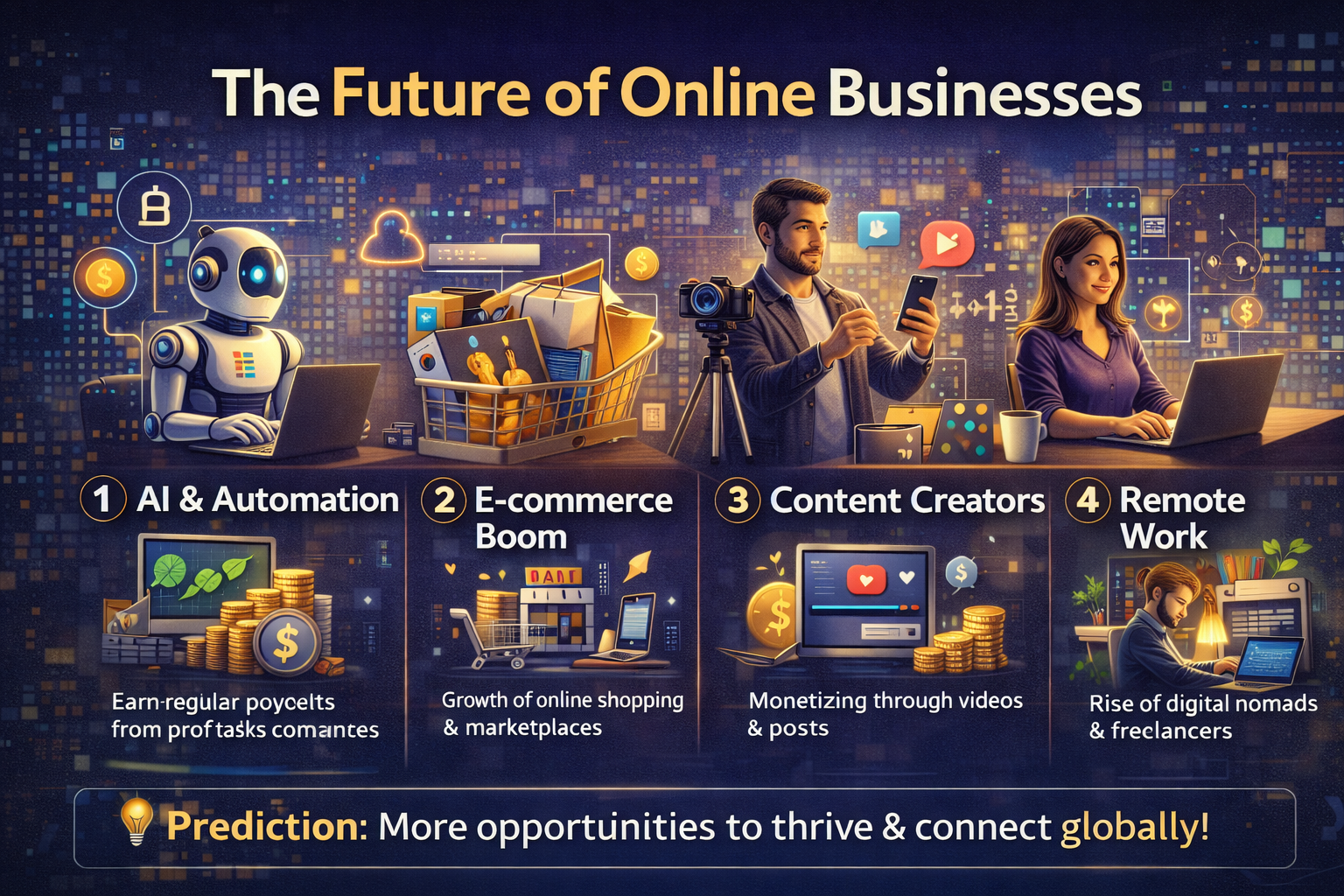
That failure taught me something important. Online businesses aren’t magic. They’re real businesses that require real strategy. But they’re also evolving faster than ever before. The tools that didn’t exist five years ago now run entire companies. The platforms that dominated yesterday are being disrupted today. The future of online businesses looks nothing like the past.
Today, we’re seeing a convergence of trends that will reshape e-commerce, digital products, remote work, and creator economies. AI is automating what used to require teams. No-code tools are democratizing software development. Marketplaces are becoming ecosystems. The barriers to entry have never been lower—and the competition has never been fiercer.
In this guide, we’ll explore the future of online businesses across 10 key trends. We’ll look at what’s working now, what’s coming next, and how you can position yourself to succeed. Whether you’re a seasoned entrepreneur or just starting out, understanding these trends will help you build a business that thrives in the years ahead.
Let’s dive into the future of online businesses.
Part 1: The State of Online Business
Before we explore the future of online businesses, let’s understand where we are today.
By the Numbers
| Metric | Data |
|---|---|
| Global e-commerce sales | $6.5 trillion |
| Percentage of retail sales online | 22% |
| Digital products market | $500 billion+ |
| Remote workers globally | 1.5 billion |
| Freelance economy value | $5 trillion |
The online economy has grown 300% in the past decade. But growth is slowing in some areas while exploding in others.
What’s Working Now
| Business Model | Growth Rate | Key Drivers |
|---|---|---|
| AI-powered SaaS | 40%+ | Businesses need AI integration |
| Digital products | 25%+ | Zero marginal cost, scalable |
| Creator memberships | 30%+ | Direct fan relationships |
| B2B e-commerce | 15%+ | Traditional B2B moving online |
| Online education | 20%+ | Upskilling demand |
What’s Struggling
| Business Model | Challenge |
|---|---|
| Generic dropshipping | Competition, thin margins |
| Ad-dependent content | Privacy changes, ad blockers |
| Marketplace reselling | Platform fees, saturation |
Part 2: Trend #1—AI-First Business Models
The future of online businesses is AI-first. Not AI as an add-on, but AI at the core.
What This Means
AI-first businesses use AI not just for efficiency, but as their primary value proposition. The product is AI. The service is AI. The competitive advantage is AI.
| Traditional Model | AI-First Model |
|---|---|
| Content agency hires writers | AI generates drafts, humans edit |
| Online course filmed once | AI adapts course to each student |
| Customer support team | AI chatbot handles 80% |
| Manual data analysis | AI finds patterns automatically |
Examples of AI-First Businesses
| Business | What They Do |
|---|---|
| Copy.ai | AI-powered copywriting |
| Synthesia | AI video generation |
| Otter.ai | AI meeting transcription |
| Jasper | AI content creation |
How to Apply
| Action | Why It Matters |
|---|---|
| Identify repetitive tasks in your business | Automate them with AI |
| Build AI into your product | Make it a feature, not an add-on |
| Use AI for customer insights | Find patterns humans miss |
| Train your team on AI tools | Efficiency is a competitive advantage |
Part 3: Trend #2—No-Code Revolution
The future of online businesses is being built by non-programmers.
What This Means
No-code platforms allow anyone to build software without writing code. A decade ago, launching a SaaS product required a technical co-founder and thousands of development hours. Today, one person can build and launch in weeks.
No-Code Stack
| Purpose | Tools |
|---|---|
| Website | Webflow, Framer, Carrd |
| E-commerce | Shopify, Gumroad, Lemon Squeezy |
| Database | Airtable, Notion, Glide |
| Automation | Zapier, Make, IFTTT |
| App builder | Bubble, Adalo, FlutterFlow |
Real-World Example
A marketer with no coding experience built a directory website for remote jobs using Webflow and Airtable. The site connects job seekers with remote employers. She charges companies $99 per job post. Within a year, she had 500 paying customers—$49,500/month. Zero code.
How to Apply
| Action | Why It Matters |
|---|---|
| Learn one no-code tool deeply | Webflow, Bubble, or Airtable |
| Build something small first | A directory, calculator, or internal tool |
| Launch before it’s perfect | Speed matters more than polish |
| Iterate based on feedback | No-code makes changes easy |
Part 4: Trend #3—The Creator Economy Matures
The future of online businesses includes millions of creators building real companies.
What This Means
The creator economy has moved from “influencer” to “entrepreneur.” Creators are no longer just selling attention. They’re selling products, memberships, software, and services.
Creator Business Models
| Model | How It Works | Example |
|---|---|---|
| Membership | Monthly subscription for exclusive content | Patreon, Substack |
| Digital products | Courses, templates, presets | Teachable, Gumroad |
| Physical products | Merch, books, tools | Shopify, Printful |
| Software | Tools for their audience | Custom-built, no-code |
| Services | Coaching, consulting, speaking | Calendly, Zoom |
The Creator Middle Class
| Tier | Income | Number of Creators |
|---|---|---|
| Hobbyist | Under $1,000/year | Millions |
| Side income | $1,000-$10,000/year | Hundreds of thousands |
| Full-time | $10,000-$100,000/year | Tens of thousands |
| Empire | $100,000+/year | Thousands |
How to Apply
| Action | Why It Matters |
|---|---|
| Build an audience first | Content drives everything |
| Offer multiple price points | Free, low, medium, premium |
| Create your own platform | Don’t rely entirely on social media |
| Diversify revenue streams | Don’t depend on one method |
Part 5: Trend #4—Decentralized Commerce
The future of online businesses includes less dependence on centralized platforms.
What This Means
For years, online businesses depended on Amazon, Google, Facebook, and Shopify. These platforms can change rules, raise fees, or ban you at any time. Entrepreneurs are increasingly building independent businesses with multiple distribution channels.
Platform Risk Examples
| Platform | Risk |
|---|---|
| Amazon | Account suspension, fee increases |
| Facebook/Instagram | Algorithm changes, ad costs |
| SEO updates, search changes | |
| Shopify | Transaction fees, policy changes |
| Apple | App Store rules, commission |
Building Independence
| Strategy | How It Works |
|---|---|
| Own your audience | Email list > social followers |
| Own your platform | Website > marketplace storefront |
| Multiple channels | Don’t depend on one traffic source |
| Direct payments | Stripe, PayPal, crypto |
| Community | Discord, Slack, Circle |
Real-World Example
A seller built a $2M/year business on Amazon. When Amazon suspended their account for a policy violation (disputed, but suspension stood), they lost everything overnight. They rebuilt on their own website, using email marketing and Instagram ads. Today, they’re back to $1.5M/year—but now they own the customer relationship.
How to Apply
| Action | Why It Matters |
|---|---|
| Build an email list from day one | You own email, not social media |
| Create a website independent of marketplaces | Your home base |
| Diversify traffic sources | SEO, social, email, referrals |
| Collect customer data (with permission) | You can reach them directly |
Part 6: Trend #5—Subscription Everything
The future of online businesses is recurring revenue.
What This Means
One-time purchases are being replaced by subscriptions. Customers prefer paying monthly to large upfront costs. Businesses prefer predictable recurring revenue.
| Industry | Subscription Examples |
|---|---|
| Software | SaaS (Microsoft, Adobe, Zoom) |
| Content | Netflix, Spotify, Substack |
| Physical goods | Dollar Shave Club, meal kits, pet supplies |
| Services | Gym memberships, coaching retainers |
| Education | MasterClass, Skillshare, Duolingo |
The Subscription Flywheel
| Stage | What Happens |
|---|---|
| 1 | Customer subscribes |
| 2 | You deliver value consistently |
| 3 | Customer stays (low churn) |
| 4 | You acquire more customers |
| 5 | Recurring revenue compounds |
How to Apply
| Action | Why It Matters |
|---|---|
| Identify a recurring need | What do customers need weekly/monthly? |
| Offer a subscription tier | Even one subscription option works |
| Reduce churn | Deliver consistent value |
| Increase lifetime value | Upsell, cross-sell, annual plans |
Part 7: Trend #6—Community-Led Growth
The future of online businesses is built around communities, not just products.
What This Means
Products can be copied. Features can be matched. Prices can be undercut. But a loyal community is defensible. Community-led growth means customers acquire other customers because they love being part of something.
Community-Led vs. Traditional
| Traditional | Community-Led |
|---|---|
| Ads to acquire customers | Customers invite others |
| Support tickets | Peer-to-peer help |
| Top-down announcements | Member-generated content |
| Transactional relationship | Emotional connection |
| High churn | Low churn |
Examples
| Business | Community |
|---|---|
| Notion | Templates shared by users |
| Figma | Design community shares work |
| Airbnb | Host community |
| Duolingo | Language learners motivate each other |
How to Apply
| Action | Why It Matters |
|---|---|
| Create a space for customers to connect | Discord, Slack, Circle, Facebook Group |
| Encourage user-generated content | Templates, reviews, testimonials |
| Highlight community members | Customer spotlights, case studies |
| Listen to community feedback | They’ll tell you what to build |
Part 8: Trend #7—Micro-SaaS
The future of online businesses includes thousands of tiny software companies.
What This Means
You don’t need to build the next Salesforce. Micro-SaaS businesses serve niche markets with simple software solutions. One person can build, launch, and maintain a profitable micro-SaaS.
Characteristics of Micro-SaaS
| Characteristic | Description |
|---|---|
| Niche audience | Specific industry or use case |
| Simple solution | Solves one problem well |
| Low overhead | One person or small team |
| Bootstrapped | No venture capital |
| Profitable | $5k-$50k/month typical |
Micro-SaaS Examples
| Product | What It Does | Revenue |
|---|---|---|
| TweetHunter | Twitter growth tools | $50k/month |
| Transistor | Podcast hosting | $40k/month |
| ConvertKit | Creator email marketing | $1M+/month |
| BannerBear | Dynamic banner images | $10k/month |
How to Apply
| Action | Why It Matters |
|---|---|
| Identify a niche problem you understand | Start with what you know |
| Build a simple MVP | One feature done well |
| Launch before you’re ready | Get feedback early |
| Charge from day one | Validation matters |
| Listen to customers | They’ll tell you what to build next |
Part 9: Trend #8—Direct-to-Avatar (D2A) Commerce
The future of online businesses includes selling to digital identities.
What This Means
People are spending more time in digital spaces—gaming platforms, virtual worlds, social apps. They’re buying digital goods for their avatars: skins, accessories, collectibles. This market is already massive and growing.
D2A Market Size
| Platform | Users | Digital Spend |
|---|---|---|
| Roblox | 200M+ monthly | Billions annually |
| Fortnite | 250M+ | Billions in skins |
| Minecraft | 140M+ | Mods, skins, servers |
| Decentraland | 500k+ | Land, wearables |
| VRChat | 40k+ daily | Avatars, worlds |
Examples of D2A Businesses
| Business | What They Sell |
|---|---|
| Roblox developers | Game passes, accessories, experiences |
| Fortnite creators | Skins, emotes, maps |
| NFT artists | Digital art, collectibles |
| VRChat creators | Avatars, worlds |
How to Apply
| Action | Why It Matters |
|---|---|
| Learn a platform’s creation tools | Roblox Studio, Unreal Engine, VRChat SDK |
| Understand the audience | What do players want? |
| Create and sell | Start with one item |
| Build a following | Discord, Twitter, platform communities |
Part 10: Trend #9—Voice Commerce
The future of online businesses includes shopping through voice assistants.
What This Means
Smart speakers (Amazon Echo, Google Home) are in 100M+ homes. Voice commerce is still early but growing. Customers can reorder products, search for items, and make purchases entirely through voice.
Voice Commerce Statistics
| Metric | Data |
|---|---|
| Smart speaker owners | 100M+ in US |
| Voice shoppers | 40M+ |
| Voice commerce value | $20B+ |
| Expected growth | 30%+ annually |
How to Prepare
| Action | Why It Matters |
|---|---|
| Optimize product names for voice | “Large coffee mug” vs “Mug, large, ceramic” |
| Enable easy reordering | Voice excels at repurchase |
| Claim your business on voice platforms | Alexa Skills, Google Actions |
| Monitor voice search | What questions lead to purchases? |
Part 11: Trend #10—Sustainable and Ethical Commerce
The future of online businesses is increasingly values-driven.
What This Means
Customers care where products come from. They want sustainable, ethical, transparent businesses. This isn’t a niche—it’s becoming mainstream.
| Customer Concern | Business Response |
|---|---|
| Environmental impact | Carbon-neutral shipping, sustainable materials |
| Labor practices | Fair wages, ethical sourcing |
| Transparency | Supply chain visibility |
| Plastic waste | Minimal packaging, recyclable materials |
| Fast fashion | Quality over quantity, repair services |
Examples
| Business | Sustainable Practice |
|---|---|
| Patagonia | Repairs clothing, donates 1% to planet |
| Allbirds | Carbon-neutral, sustainable materials |
| Package Free | Zero-waste products |
| Who Gives A Crap | Tree-free toilet paper, donates 50% of profits |
How to Apply
| Action | Why It Matters |
|---|---|
| Audit your supply chain | Know where materials come from |
| Reduce packaging waste | Minimal, recyclable, compostable |
| Be transparent | Share your practices openly |
| Certify where possible | B Corp, Climate Neutral, Fair Trade |
| Tell your story | Customers want to support values-aligned brands |
Part 12: How to Prepare for the Future
The future of online businesses is uncertain, but you can prepare.
Skills That Will Matter
| Skill | Why It Matters |
|---|---|
| AI literacy | AI will be in every business |
| No-code development | Build without technical teams |
| Data analysis | Make decisions with data |
| Community building | Defensible advantage |
| Adaptability | The only constant is change |
Mindset Shifts
| Old Mindset | New Mindset |
|---|---|
| “Build it and they will come” | “Market from day one” |
| “One revenue stream” | “Multiple diversified streams” |
| “Owned platform” | “Own audience, rent platform” |
| “Exit is the goal” | “Sustainable business is the goal” |
Conclusion
Let’s bring this together.
The future of online businesses is being written right now. AI is automating what used to require teams. No-code is democratizing software creation. Creators are building real companies. Communities are becoming moats. Subscriptions are replacing one-time purchases. Micro-SaaS is proving that small can be beautiful. Digital commerce is expanding into virtual worlds. Voice commerce is slowly emerging. And customers increasingly care about values, not just value.
The opportunities are enormous. The barriers to entry have never been lower. But the competition has never been fiercer. The businesses that succeed will be those that embrace these trends, adapt quickly, and build something people genuinely want.
You don’t need to do everything. Pick one trend that resonates with you. Learn it. Build something small. Launch. Iterate. Scale.
The future isn’t something that happens to you. It’s something you build.
Start today.



Leave a Reply