

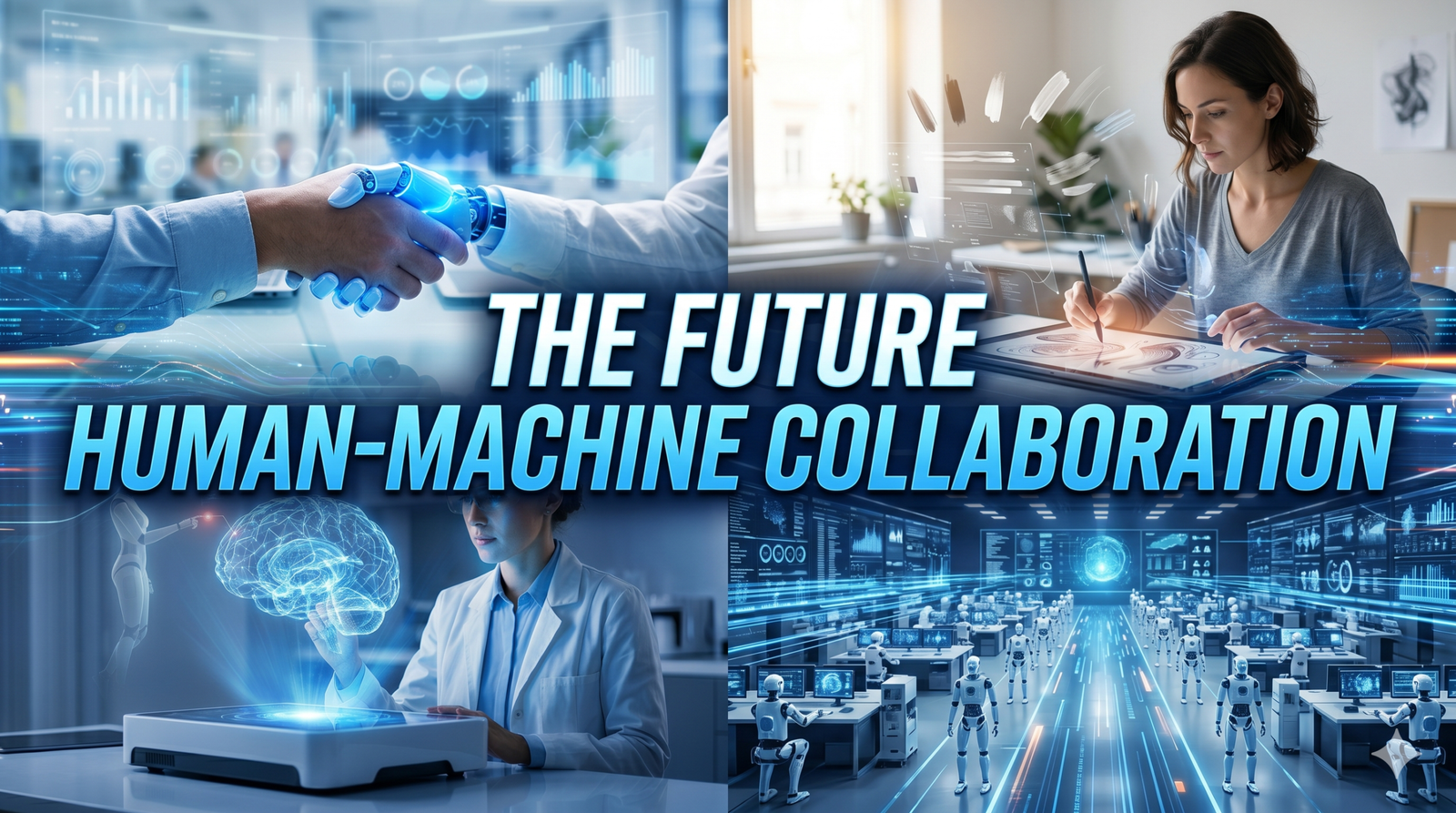
I remember the first time I truly collaborated with AI, not just used it. It wasn’t the typical back-and-forth of asking ChatGPT a question and getting an answer. It was different. Deeper.
I was stuck on a complex problem at work—a data analysis that required insights I couldn’t see. I uploaded the messy spreadsheet to an AI tool and asked it to find patterns. It found three I’d missed entirely. Then I took those patterns, applied my business context, and built a strategy that doubled our team’s efficiency.
That moment changed how I think about technology. I wasn’t using a tool. I was collaborating with a partner. The AI saw what I couldn’t. I understood what the AI couldn’t. Together, we were better than either of us alone.
That’s the promise of the future of human-machine collaboration. Not humans replaced by machines. Not machines serving humans. Humans and machines working together, each doing what they do best.
In this guide, we’ll explore how human-machine collaboration is evolving across industries, what it means for workers, and how you can prepare for a world where AI is your teammate, not just your tool.
Let’s dive into the future of human-machine collaboration.
Part 1: From Tool to Teammate
Before we explore the future, let’s understand the past. The relationship between humans and machines has gone through distinct phases.
The Three Phases of Human-Machine Relationship
| Phase | Description | Example |
|---|---|---|
| Tool | Machine does what human directs | Calculator, spreadsheet, word processor |
| Assistant | Machine anticipates needs, suggests actions | Autocomplete, grammar check, recommendations |
| Teammate | Machine collaborates, initiates, takes independent action | AI agent that identifies problems, proposes solutions, executes |
Most of us are still in Phase 2. The future of human-machine collaboration is Phase 3.
What Makes a Teammate Different
| Characteristic | Tool | Assistant | Teammate |
|---|---|---|---|
| Initiative | None | Suggests | Acts independently |
| Understanding | None | Pattern recognition | Context understanding |
| Learning | None | Updates with new data | Continuous adaptation |
| Communication | One-way | Basic dialogue | Natural conversation |
| Accountability | Human | Human | Shared (evolving) |
Part 2: The Strengths of Each Partner
Effective collaboration requires understanding what each partner brings. The future of human-machine collaboration depends on playing to strengths.
What Machines Do Best
| Strength | Example |
|---|---|
| Process vast data | Analyze millions of transactions for fraud |
| Work 24/7 | Customer service chatbots |
| Never tire | Quality control inspection |
| Perfect memory | Recall every customer interaction |
| No emotion | Objective decision-making |
| Speed | Execute trades in milliseconds |
| Consistency | Follow rules exactly every time |
What Humans Do Best
| Strength | Example |
|---|---|
| Context | Understand nuance, sarcasm, cultural references |
| Creativity | Generate genuinely novel ideas |
| Ethics | Make value-based decisions |
| Empathy | Connect emotionally with others |
| Judgment | Weigh competing priorities |
| Adaptability | Handle completely novel situations |
| Accountability | Take responsibility for outcomes |
The Perfect Partnership
| Task | Machine Role | Human Role |
|---|---|---|
| Medical diagnosis | Analyze scans, flag anomalies | Interpret results, communicate with patient |
| Legal research | Find relevant cases, summarize | Build argument, advise client |
| Customer service | Handle routine questions | Resolve complex issues, show empathy |
| Software development | Generate boilerplate, test | Design architecture, review quality |
| Content creation | Draft, research, edit | Set strategy, add voice, approve |
Part 3: How Collaboration Is Already Changing Work
The future of human-machine collaboration isn’t distant. It’s happening now.
Healthcare
| Role | AI Collaboration | Human Role |
|---|---|---|
| Radiologist | AI flags suspicious areas | Confirm, diagnose, communicate |
| Surgeon | AI provides real-time guidance | Execute procedure, make judgment calls |
| Primary care | AI analyzes symptoms, suggests tests | Interview patient, make final diagnosis |
| Nurse | AI monitors vitals, alerts to changes | Provide care, comfort, communication |
Real-world example: In 2025, a study found that radiologists assisted by AI detected 8% more cancers with 10% fewer false positives than radiologists working alone.
Education
| Role | AI Collaboration | Human Role |
|---|---|---|
| Teacher | AI tutors provide personalized practice | Explain concepts, motivate, mentor |
| Student | AI helps research, outline, edit | Think critically, create, revise |
| Administrator | AI schedules, tracks, reports | Make strategic decisions, lead |
Real-world example: Schools using AI tutoring systems saw students learn twice as fast as those in traditional classrooms—but only when teachers used the AI insights to guide instruction.
Software Development
| Role | AI Collaboration | Human Role |
|---|---|---|
| Developer | AI generates code, suggests fixes | Design architecture, review quality |
| QA | AI writes tests, finds edge cases | Verify critical paths, approve releases |
| Product manager | AI analyzes user feedback, suggests features | Set vision, prioritize, communicate |
Real-world example: Developers using GitHub Copilot completed tasks 56% faster than those without—but the highest-performing developers used AI suggestions as a starting point, not a final answer.
Part 4: The New Skills for Human-Machine Collaboration
As the future of human-machine collaboration unfolds, the skills that matter are changing.
Skills That Are Becoming More Important
| Skill | Why It Matters |
|---|---|
| Prompt engineering | Getting the best from AI requires clear communication |
| Critical thinking | Evaluating AI outputs for accuracy and bias |
| Problem decomposition | Breaking complex problems into AI-solvable pieces |
| Context awareness | Understanding when AI is reliable, when it’s not |
| Ethical judgment | Making decisions AI can’t |
| Creativity | Generating novel ideas AI can’t predict |
| Emotional intelligence | Human connection AI can’t replicate |
Skills That Are Becoming Less Important
| Skill | Why It Matters Less |
|---|---|
| Memorization | AI can recall facts instantly |
| Routine calculation | AI handles math |
| Basic data entry | AI automates |
| Simple coding | AI generates code |
| Translation | AI translates |
The T-Shaped Professional
| Shape | Description |
|---|---|
| Vertical bar | Deep expertise in one domain |
| Horizontal bar | Broad understanding of AI, data, collaboration |
The most valuable professionals in the future of human-machine collaboration will have both deep domain expertise and the ability to work effectively with AI.
Part 5: Industries Being Transformed
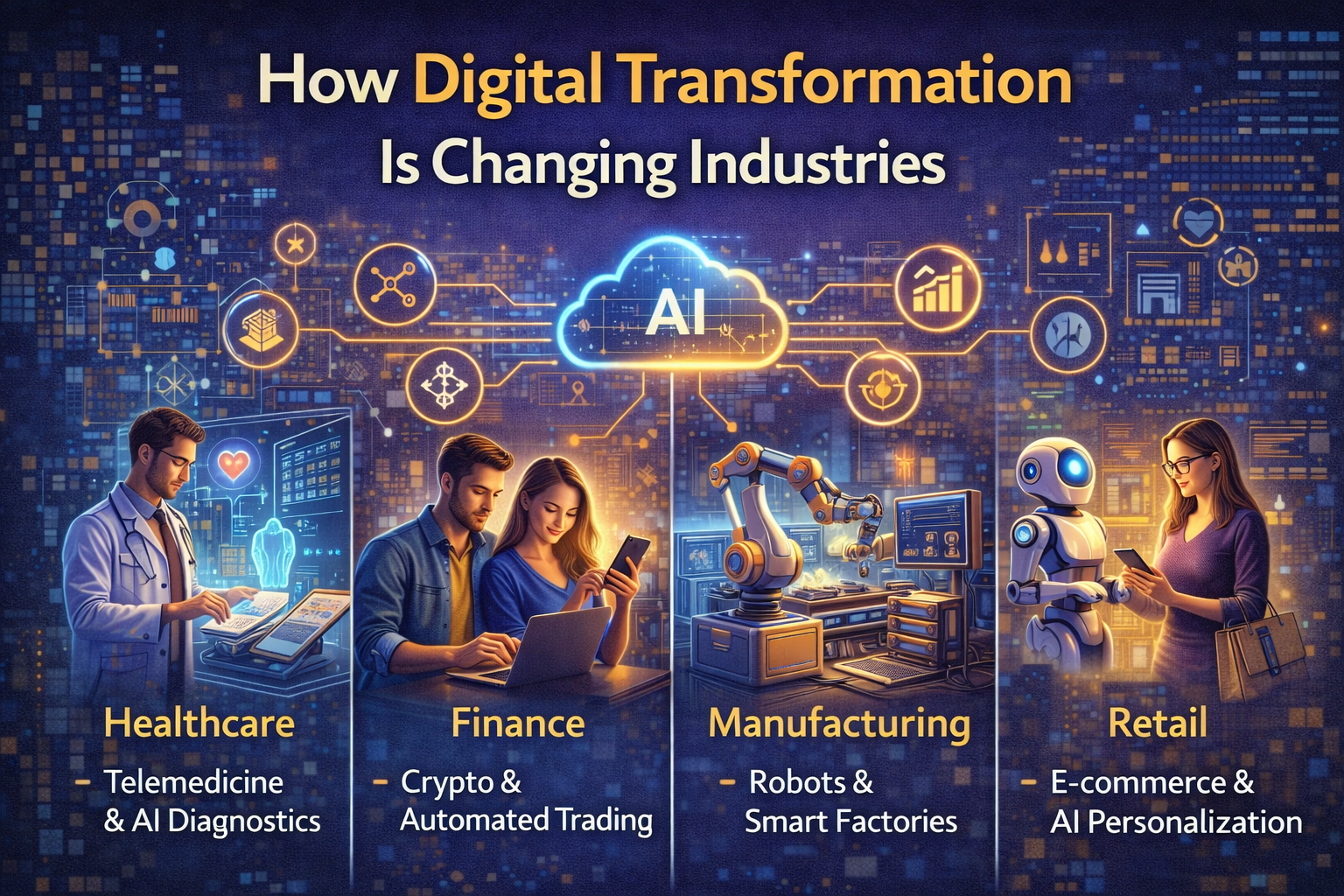
Let’s look at specific industries and how human-machine collaboration is reshaping them.
Finance
| Area | Machine Role | Human Role |
|---|---|---|
| Trading | Execute trades, identify patterns | Set strategy, manage risk |
| Fraud detection | Flag suspicious transactions | Investigate, decide |
| Customer service | Answer routine questions | Handle complex issues |
| Research | Analyze data, generate reports | Interpret, recommend |
Example: A financial analyst spends less time gathering data and more time interpreting insights and advising clients.
Manufacturing
| Area | Machine Role | Human Role |
|---|---|---|
| Quality control | Visual inspection, defect detection | Investigate root causes |
| Maintenance | Predict failures | Schedule, perform repairs |
| Production planning | Optimize schedules | Adjust for exceptions |
| Safety | Monitor conditions | Respond to alerts |
Example: A factory worker is freed from repetitive inspection to focus on continuous improvement and problem-solving.
Law
| Area | Machine Role | Human Role |
|---|---|---|
| Legal research | Find relevant cases | Apply to client situation |
| Document review | Identify relevant documents | Make judgment calls |
| Contract analysis | Flag unusual clauses | Negotiate terms |
| Due diligence | Process large volumes | Identify key risks |
Example: A junior associate spends less time reviewing documents and more time building legal strategy.
Part 6: The Psychological Shift
The future of human-machine collaboration requires a psychological shift as much as a skills shift.
From Control to Trust
| Old Mindset | New Mindset |
|---|---|
| “I must understand everything” | “I trust AI for what it does well” |
| “I need to be the expert” | “I need to know when to defer to AI” |
| “Machines are tools” | “Machines are teammates” |
| “I give commands” | “I collaborate” |
From Fear to Curiosity
| Fear-Based Response | Curiosity-Based Response |
|---|---|
| “AI will replace me” | “How can AI amplify me?” |
| “I don’t understand this” | “Let me learn how this works” |
| “This is threatening” | “This is interesting” |
| “I’ll resist change” | “I’ll adapt” |
The Collaboration Mindset
| Principle | What It Means |
|---|---|
| Complement, don’t compete | Focus on what you do best, let AI do the rest |
| Verify, don’t trust blindly | AI is powerful but not perfect |
| Learn continuously | Tools will evolve; you must too |
| Stay human | Empathy, creativity, judgment are your advantages |
Part 7: Challenges and Risks
No vision of the future of human-machine collaboration is complete without addressing the challenges.
Challenge #1: Trust
People don’t trust AI they don’t understand. And they shouldn’t trust it blindly.
| Solution | Why It Works |
|---|---|
| Explainable AI | Systems that show their reasoning |
| Training | Helping people understand AI capabilities and limits |
| Testing | Building confidence through experience |
Challenge #2: Skill Gaps
Most people aren’t prepared to work alongside AI.
| Solution | Why It Works |
|---|---|
| Continuous learning | Skills need constant updating |
| AI literacy programs | Basic understanding for everyone |
| On-the-job training | Learning by doing |
Challenge #3: Over-Reliance
People may trust AI too much, abdicating judgment.
| Solution | Why It Works |
|---|---|
| Human review requirements | Critical decisions require human sign-off |
| Confidence scores | AI indicates uncertainty |
| Red teaming | Testing where AI fails |
Challenge #4: Algorithmic Bias
AI systems can perpetuate or amplify human biases.
| Solution | Why It Works |
|---|---|
| Diverse training data | Reduces bias |
| Regular audits | Identifies problems |
| Human oversight | Catches what AI misses |
Part 8: Preparing for the Future
Whether you’re an individual or an organization, you can prepare for the future of human-machine collaboration.
For Individuals
| Action | Why It Matters |
|---|---|
| Learn AI basics | Understand capabilities and limits |
| Practice prompting | Get better results from AI |
| Identify your strengths | Focus on what AI can’t do |
| Stay curious | Technology will evolve |
| Build human skills | Empathy, creativity, judgment |
For Organizations
| Action | Why It Matters |
|---|---|
| Invest in training | Skills gaps are the biggest barrier |
| Redesign roles | Shift humans to judgment, not routine |
| Create AI ethics guidelines | Establish boundaries |
| Experiment continuously | What works today may not work tomorrow |
| Measure outcomes | Track both efficiency and quality |
Part 9: What Success Looks Like
In the ideal version of the future of human-machine collaboration, what does success look like?
At Work
| Scenario | Success |
|---|---|
| Morning | AI summarizes overnight developments, prioritizes tasks |
| Deep work | AI handles routine tasks while you focus on complex problems |
| Meetings | AI takes notes, tracks action items |
| Decision-making | AI provides data, options; you provide judgment |
| Creativity | AI generates possibilities; you choose and refine |
In Daily Life
| Scenario | Success |
|---|---|
| Health | AI monitors, alerts; you make lifestyle changes |
| Learning | AI tutors adapt to your pace; you direct your learning journey |
| Finance | AI tracks spending, suggests savings; you set goals |
| Creativity | AI helps generate ideas; you create meaning |
Part 10: The Long View
Where is the future of human-machine collaboration headed in 10, 20, or 50 years?
Near-Term (1-3 Years)
| Trend | What to Expect |
|---|---|
| AI agents | Delegating tasks to autonomous AI |
| Natural collaboration | AI that understands context, not just commands |
| Specialized AI | AI trained for specific roles (doctor, lawyer, teacher) |
Medium-Term (3-10 Years)
| Trend | What to Expect |
|---|---|
| AI teammates | AI with defined roles in organizations |
| Continuous learning | AI that improves with every interaction |
| Human-AI teams | Formal collaboration structures |
Long-Term (10+ Years)
| Possibility | What It Could Mean |
|---|---|
| AI with true understanding | Not just pattern matching |
| Seamless integration | AI that anticipates needs |
| Redefined work | Humans focus on uniquely human activities |
Conclusion
Let’s bring this together.
The future of human-machine collaboration isn’t about humans versus machines. It’s about humans and machines together, each doing what they do best.
Machines bring speed, scale, memory, and consistency. Humans bring context, creativity, ethics, empathy, and judgment. Together, we can achieve what neither can alone.
The organizations and individuals who thrive will be those who embrace collaboration, not resistance. Who learn new skills, not cling to old ones. Who see AI as a teammate, not a threat.
The question isn’t whether AI will change how we work. It already is. The question is whether you’ll be left behind or leading the way.
Your collaboration with AI starts today.




Leave a Reply