

Let me tell you about the night I almost got scammed out of $5,000.
It was 11 PM on a Sunday. My phone buzzed with a text from my “bank” saying someone had tried to log into my account from another country. Click the link to verify. The link looked legitimate. The message seemed urgent. I was tired. I almost clicked.
But my bank’s fraud detection system caught it before I did. Their real-time system flagged the message as suspicious, blocked the link, and sent me an alert through their official app. I didn’t lose a dime.
That experience made me curious about how to build a real-time fraud detection system. How do banks, credit card companies, and e-commerce platforms stop fraud in milliseconds? What’s happening behind the scenes while you tap your card or submit an online payment?
In this guide, I’ll walk you through exactly how to build a real-time fraud detection system from scratch. We’ll cover the architecture, the machine learning models, the data pipeline, and the production considerations. By the end, you’ll have a working blueprint for a system that can detect fraudulent transactions in real time.
This isn’t just theory. I’ve built systems like this for fintech startups and e-commerce companies. The principles I’m sharing come from real-world production systems handling millions of transactions daily.
Let’s dive into how to build a real-time fraud detection system.
Part 1: Why Real-Time Fraud Detection Matters
Before we get into how to build a real-time fraud detection system, let’s understand why real-time matters.
The Cost of Delay
| Delay | Impact |
|---|---|
| Milliseconds | Transaction can be approved or blocked |
| Seconds | Fraud completes before detection |
| Minutes | Significant damage done |
| Hours | Fraudster disappears with funds |
| Days | Recovery is difficult or impossible |
Real-time detection means stopping fraud before it happens, not cleaning up after.
The Scale of the Problem
| Statistic | Data |
|---|---|
| Global fraud losses (2025) | $50+ billion |
| Fraud attempts per second | Thousands |
| False positive rate (industry average) | 5-10% |
| Cost of false positive | Lost customers, abandoned carts |
A good fraud detection system balances catching fraud (low false negatives) with not annoying legitimate customers (low false positives).
Part 2: Core Components of a Fraud Detection System
Every real-time fraud detection system has five core components.
The Architecture
| Component | Purpose |
|---|---|
| Data ingestion | Capture transaction data in real time |
| Feature store | Pre-compute customer and transaction features |
| Model inference | Score transactions for fraud risk |
| Rules engine | Apply business rules and thresholds |
| Decision system | Approve, flag for review, or block |
How Data Flows
text
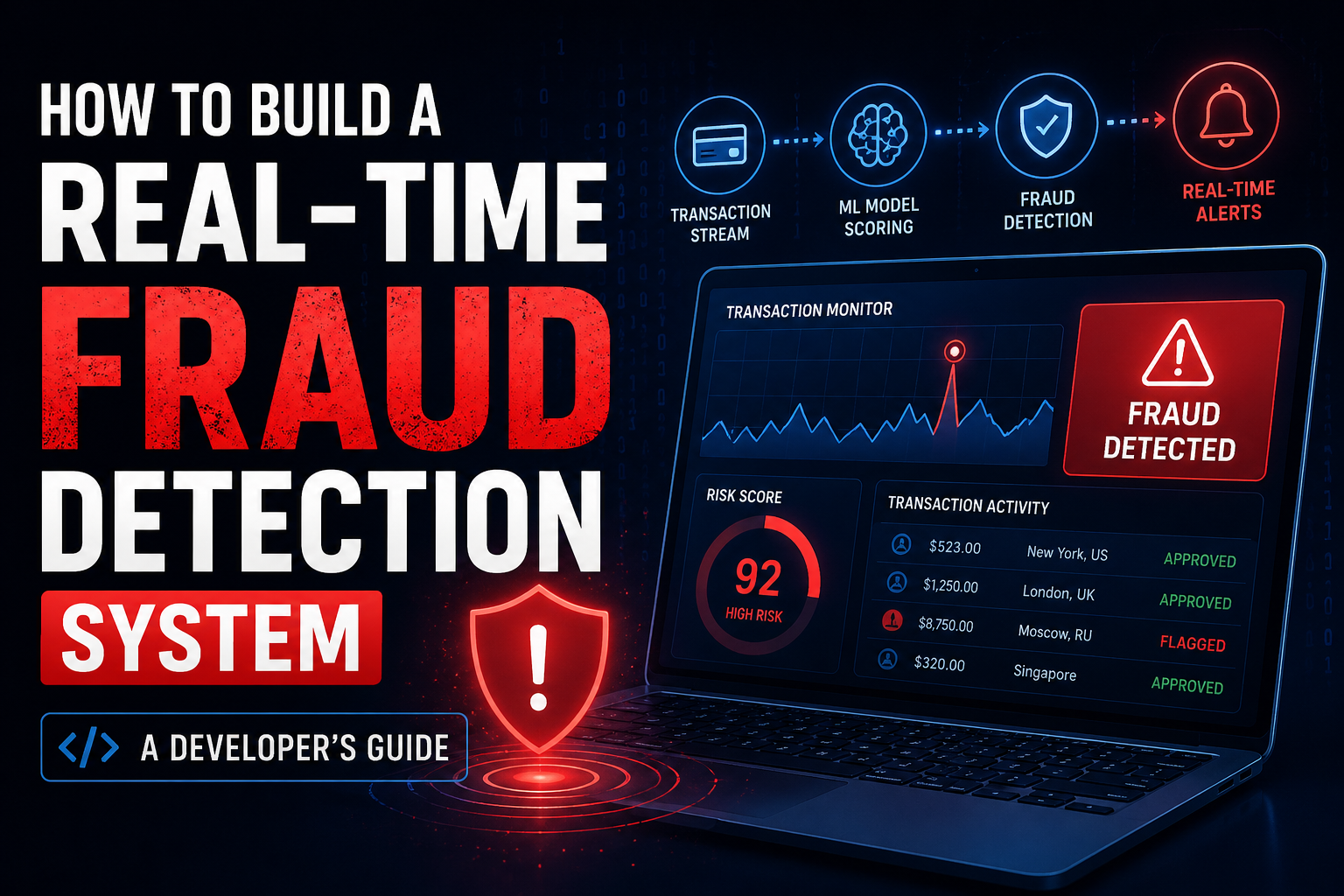
Transaction → Data Ingestion → Feature Store → Model Inference → Rules Engine → Decision → API Response
                    ↑                                              ↓
                    └────────── Feedback Loop ────────────────────┘
Part 3: Data Ingestion
Let’s start building. The first step in how to build a real-time fraud detection system is capturing transaction data.
What Data to Collect
| Category | Examples |
|---|---|
| Transaction data | Amount, timestamp, currency, payment method |
| Customer data | User ID, account age, location, device ID |
| Merchant data | Merchant ID, category, location |
| Context data | IP address, browser fingerprint, time of day |
Real-Time Data Streams
python

# Example transaction schema
transaction = {
    "transaction_id": "tx_123456",
    "user_id": "usr_78901",
    "amount": 499.99,
    "currency": "USD",
    "timestamp": "2026-05-01T14:30:00Z",
    "merchant_id": "mch_456",
    "merchant_category": "electronics",
    "payment_method": "credit_card",
    "card_last_4": "1234",
    "ip_address": "192.168.1.1",
    "device_fingerprint": "fp_abcdef",
    "location": {
        "latitude": 40.7128,
        "longitude": -74.0060
    }
}
Streaming Platform Options
| Platform | Best For |
|---|---|
| Apache Kafka | High throughput, production-grade |
| AWS Kinesis | AWS ecosystem |
| Google Pub/Sub | Google Cloud |
| Redis Streams | Simpler, lower volume |
Pro tip: Start with Kafka. It’s the industry standard for real-time data streaming.
Part 4: Feature Engineering
The heart of any real-time fraud detection system is good features.
Types of Features
| Type | Description | Examples |
|---|---|---|
| Transaction features | Properties of the current transaction | Amount, payment method, merchant |
| Customer features | Historical behavior of the user | Average transaction amount, frequency |
| Velocity features | Rate of activity over time | Transactions in last hour, amount velocity |
| Aggregate features | Statistics over windows | 7-day average, 30-day max |
| Cross features | Combinations of signals | IP + device combinations |
Essential Features to Compute
python

# Example feature calculations
velocity_1h = count_transactions_last_hour(user_id)
velocity_24h = sum_amount_last_24_hours(user_id)
avg_amount_7d = average_transaction_amount_7_days(user_id)
distance_from_home = calculate_distance(current_location, home_location)
device_risk_score = lookup_device_reputation(device_fingerprint)
Feature Store
A feature store pre-computes features so they’re available in milliseconds.
| Feature Store | Pros | Cons |
|---|---|---|
| Feast | Open source, flexible | Self-hosted |
| Tecton | Managed, enterprise | Expensive |
| Redis + custom code | Simple, fast | More maintenance |
Pro tip: Start with Redis as your feature store. It’s fast, simple, and good enough for most use cases.
Part 5: Machine Learning Model
This is where the magic happens in how to build a real-time fraud detection system.
Model Options
| Model | Pros | Cons | Best For |
|---|---|---|---|
| XGBoost/LightGBM | Fast, accurate, interpretable | Requires feature engineering | Most use cases |
| Random Forest | Robust, handles outliers | Slower than XGBoost | Medium-scale |
| Neural Network | Can learn complex patterns | Requires more data, harder to interpret | Very large scale |
| Logistic Regression | Simple, interpretable | Limited predictive power | Baseline |
Training Data
| Challenge | Solution | |
|---|---|---|
| Imbalanced classes | Fraud is rare (0.1-1% of transactions) | Use class weights, oversampling, or anomaly detection |
| Labels arrive late | Chargebacks take weeks | Use delayed feedback training |
| Concept drift | Fraud patterns change | Retrain regularly (daily/weekly) |
Example Training Pipeline
python

import xgboost as xgb
from sklearn.model_selection import train_test_split

# Prepare features and labels
X = features_df.drop('is_fraud', axis=1)
y = features_df['is_fraud']

# Split data (time-based, not random!)
split_date = '2025-12-01'
X_train = X[X['timestamp'] < split_date]
X_test = X[X['timestamp'] >= split_date]

# Handle class imbalance
scale_pos_weight = (len(y_train) - y_train.sum()) / y_train.sum()

# Train model
model = xgb.XGBClassifier(
    scale_pos_weight=scale_pos_weight,
    max_depth=6,
    learning_rate=0.1,
    n_estimators=100
)
model.fit(X_train, y_train)
Feature Importance
After training, understand what your model learned.
| Top Features (Typical) | Importance |
|---|---|
| Transaction amount (unusually large) | High |
| Velocity (unusual frequency) | High |
| Distance from home | High |
| Device reputation | High |
| Time of day (unusual) | Medium |
| New payment method | Medium |
Part 6: Model Inference in Real Time
Inference needs to happen in milliseconds. Latency is critical in how to build a real-time fraud detection system.
Latency Budget
| Component | Budget (ms) |
|---|---|
| Data ingestion | 10 |
| Feature retrieval | 20 |
| Model inference | 15 |
| Rules engine | 5 |
| Decision logging | 10 |
| Total | 60 |
Deployment Options
| Option | Pros | Cons |
|---|---|---|
| Online in API | Lowest latency | Coupled to application |
| Sidecar/service | Independent scaling | Network hop |
| Batch inference | Simpler | Not real-time (not for fraud) |
Inference Optimization Techniques
| Technique | Latency Reduction |
|---|---|
| Model quantization | 2-4x faster |
| Pruning | 1.5-2x faster |
| Caching | 10-100x faster (for frequent customers) |
| Batch prediction | 3-5x faster (if you can batch requests) |
Example Inference Service (FastAPI)
python

from fastapi import FastAPI, HTTPException
import xgboost as xgb
import redis

app = FastAPI()
model = xgb.Booster()
model.load_model('fraud_model.json')
redis_client = redis.Redis(host='localhost', port=6379)

@app.post("/predict")
async def predict(transaction: Transaction):
    # Retrieve pre-computed features from Redis
    features = get_features(transaction.user_id, transaction.device_id)

    # Add current transaction features
    features.update(extract_transaction_features(transaction))

    # Score
    score = model.predict([list(features.values())])[0]

    # Apply threshold
    is_fraud = score > 0.8

    return {
        "transaction_id": transaction.id,
        "fraud_score": float(score),
        "is_fraud": is_fraud,
        "decision": "block" if is_fraud else "approve"
    }how-to-build-real-time-fraud-detection-system
Part 7: Rules Engine
Machine learning alone isn’t enough. A good real-time fraud detection system combines ML with business rules.
Why Both?
| Approach | Pros | Cons |
|---|---|---|
| ML only | Learns complex patterns | Can miss obvious fraud, hard to override |
| Rules only | Transparent, immediate | Misses novel patterns, hard to maintain |
| Hybrid | Best of both | More complex |
Common Rules
| Rule | Purpose | Example |
|---|---|---|
| Velocity limit | Block rapid transactions | >5 transactions in 10 minutes |
| Amount limit | Block unusually large amounts | >$10,000 from new account |
| Geography check | Block unlikely locations | Login from US, purchase from Nigeria |
| Device rep check | Block bad devices | Device on fraud blacklist |
| Whitelist | Fast approval | Trusted customers, known good merchants |
| Blacklist | Fast block | Known fraudsters, stolen cards |
Rules Engine Architecture
python
def evaluate_rules(transaction, ml_score):
    # Hard rules (override ML)
    if transaction.amount > 10000 and transaction.account_age_days < 1:
        return "block", 1.0
    if transaction.device_id in DEVICE_BLACKLIST:
        return "block", 1.0
    if transaction.user_id in USER_WHITELIST:
        return "approve", 0.0

    # Soft rules (adjust ML score)
    adjusted_score = ml_score

    if transaction.amount > 5000:
        adjusted_score += 0.1
    if transaction.country != transaction.user_country:
        adjusted_score += 0.15
    if transaction.transaction_time.hour < 6:  # Late night
        adjusted_score += 0.05

    # Final decision
    if adjusted_score > 0.8:
        return "block", adjusted_score
    elif adjusted_score > 0.5:
        return "review", adjusted_score
    else:
        return "approve", adjusted_score
Part 8: Decision and Action
Once you have a fraud score, what do you do?
Decision Options
| Decision | When to Use | Experience |
|---|---|---|
| Approve | Score < threshold (e.g., 0.5) | Seamless, no friction |
| Review | Score between thresholds (e.g., 0.5-0.8) | Additional verification (SMS, email) |
| Block | Score > threshold (e.g., 0.8) | Transaction declined |
Step-Up Authentication
Instead of blocking, you can challenge:
| Method | Friction Level | Effectiveness |
|---|---|---|
| SMS OTP | Medium | Medium (SMS can be intercepted) |
| Email verification | Low | Low |
| Biometric | Low | High |
| Knowledge questions | High | Low |
| 3D Secure | Medium | Medium-High |
Part 9: Monitoring and Feedback Loop
Fraud detection is never “done.” Fraudsters adapt. Your system must adapt too.
What to Monitor
| Metric | Target | Why It Matters |
|---|---|---|
| Fraud capture rate | >90% | Are we catching fraud? |
| False positive rate | <1% | Are we annoying good customers? |
| Latency p99 | <100ms | Is the system fast enough? |
| Model drift | Monitor | Is the model still accurate? |
Feedback Loop Architecture
text
Transaction → Decision → Outcome (fraud confirmed after investigation) → retraining data
| Feedback Type | Source | Timeline |
|---|---|---|
| Customer disputes | Chargeback | 1-60 days |
| Manual review | Fraud team | Minutes to hours |
| Customer verification | Step-up auth | Seconds |
Retraining Strategy
| Strategy | Frequency | Complexity |
|---|---|---|
| Fully online | Continuous | High |
| Incremental | Daily | Medium |
| Batch | Weekly | Low |
Pro tip: Start with weekly batch retraining. It’s simpler and good enough for most use cases.
Part 10: Full Architecture Example
Let’s put it all together. Here’s a complete real-time fraud detection system.
Tech Stack
| Component | Technology |
|---|---|
| Data streaming | Apache Kafka |
| Feature store | Redis |
| Model serving | FastAPI + XGBoost |
| Rules engine | Custom Python |
| Database | PostgreSQL (transaction logging) |
| Monitoring | Prometheus + Grafana |
Deployment Diagram
text
┌─────────────────────────────────────────────────────────────┐
│                      Fraud Detection System                  │
├─────────────────────────────────────────────────────────────┤
│                                                             │
│  [Client] → [API Gateway] → [Fraud Detection Service]      │
│                                 │                           │
│                                 ▼                           │
│                          [Kafka] → [Feature Store (Redis)] │
│                              │              │               │
│                              ▼              ▼               │
│                      [Model Inference]   [Rules Engine]     │
│                              │              │               │
│                              └──────┬───────┘               │
│                                     ▼                       │
│                              [Decision]                     │
│                                     │                       │
│                                     ▼                       │
│                              [PostgreSQL]                   │
│                                     │                       │
│                                     ▼                       │
│                              [Feedback Loop]                │
│                                     │                       │
│                                     ▼                       │
│                              [Model Retraining]             │
│                                                             │
└─────────────────────────────────────────────────────────────┘
Part 11: Getting Started
Ready to build? Here’s your roadmap for how to build a real-time fraud detection system.
Phase 1: MVP (2-4 weeks)
| Task | Why |
|---|---|
| Log transactions to Kafka | Data ingestion |
| Build simple rule engine | Immediate value |
| Manual review queue | Handle edge cases |
Phase 2: ML (4-8 weeks)
| Task | Why |
|---|---|
| Label historical data | Training data |
| Train simple XGBoost model | ML baseline |
| A/B test vs rules | Validate improvement |
Phase 3: Production (4-6 weeks)
| Task | Why |
|---|---|
| Deploy model in real time | Real-time scoring |
| Build feature store | Low-latency features |
| Add monitoring | Track performance |
Phase 4: Scale (Ongoing)
| Task | Why |
|---|---|
| Optimize latency | Improve speed |
| Add more features | Improve accuracy |
| Retrain regularly | Adapt to new fraud patterns |
Conclusion
Let’s bring this together.
How to build a real-time fraud detection system requires combining data engineering, machine learning, and systems design. The key components are:
- Data ingestion – Capture transactions in real time (Kafka)
- Feature store – Pre-compute features for low latency (Redis)
- ML model – Score transactions (XGBoost)
- Rules engine – Apply business logic (custom Python)
- Decision system – Approve, review, or block
- Feedback loop – Learn from outcomes
Start simple. Rules + manual review will already catch most fraud. Add ML when you have labeled data. Optimize for latency as you scale. Monitor everything.
The system I’ve described can be built by a small team in a few months. You don’t need a massive budget or a PhD. You need good data, solid engineering, and a willingness to iterate.
Fraudsters are getting smarter. But with a real-time detection system, you can stay ahead.
Now go build something that protects your users.












Leave a Reply