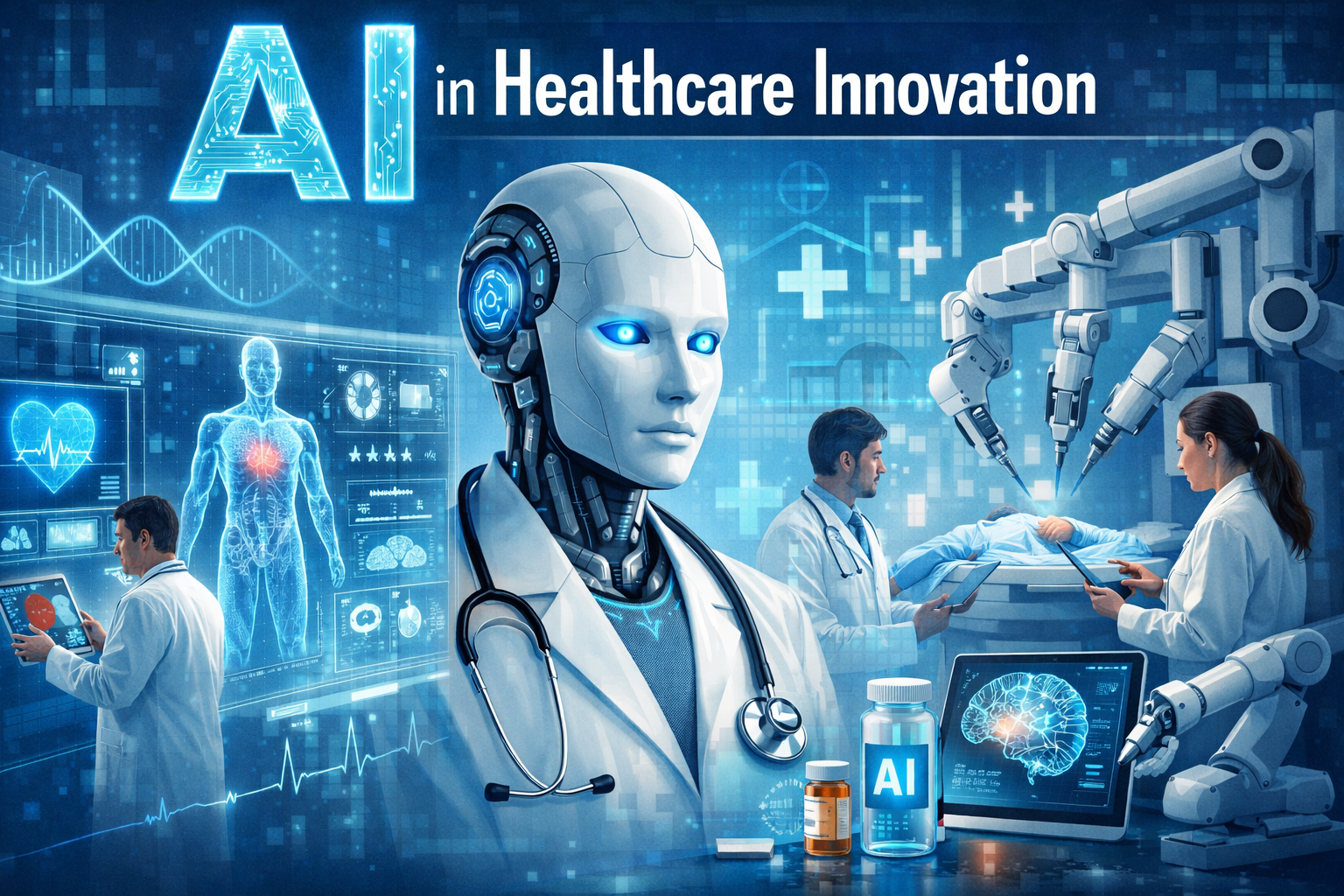
Imagine walking into a doctor’s office where your medical history isn’t just a file in a cabinet, but a living, breathing data model that updates in real time. Your wearable devices have already flagged subtle changes in your heart rhythm that no human could detect. An AI system has analyzed those changes against millions of similar cases and predicted—with 94% confidence—that you’re developing a condition that typically goes undiagnosed until it’s advanced. Your doctor reviews the AI’s findings, asks you a few questions, and together you design a preventive plan. No symptoms yet. No crisis. Just data, insight, and action.
This isn’t science fiction. This is AI in healthcare innovation happening right now.
The numbers are staggering. The FDA has already approved more than 250 AI applications for medical imaging alone . Hospitals using AI for administrative tasks report saving nurses up to 30% of their time . And in drug discovery, AI is compressing timelines from decades to months .
But behind these numbers are real human stories. The radiologist who catches cancers she would have missed. The rural clinic that now offers specialist-level diagnostic support. The patient whose rare disease was finally identified after years of misdiagnosis.
In this guide, we’ll explore the landscape of AI in healthcare innovation—where it’s making the biggest impact, what’s actually working, and what the future holds. We’ll look at diagnostics, drug discovery, personalized medicine, administrative efficiency, and the ethical questions we must answer along the way.
Let’s dive into the quiet revolution that’s reshaping medicine.
Part 1: The State of AI in Healthcare Innovation Today
The integration of AI in healthcare innovation has accelerated dramatically over the past five years. What was once experimental is now clinical reality.
By the Numbers
| Metric | Data |
|---|---|
| FDA-approved AI medical devices | 250+ |
| Healthcare organizations using AI | 9% (projected to reach 15% in 2026) |
| AI in drug discovery market | Projected $5.6 billion by 2028 |
| Physician adoption of AI tools | 48% of U.S. physicians now use AI in practice |
The momentum isn’t slowing. Venture capital investment in healthcare AI reached $10.8 billion in 2024 . Major health systems are embedding AI into their workflows. And the technology is moving from administrative applications to direct clinical care.
Why Now?
Several factors have converged to accelerate AI in healthcare innovation:
- Data availability: Electronic health records, genomic data, wearable devices, and medical imaging create unprecedented datasets
- Computing power: AI models that once required supercomputers now run on cloud infrastructure
- Algorithm maturity: Deep learning has moved from research labs to validated clinical tools
- Regulatory clarity: The FDA has created pathways for AI/ML-based software as a medical device
- Workforce pressures: Healthcare systems are desperate for tools that can extend clinician capacity
Part 2: Diagnostic AI—Seeing What Humans Miss
Diagnostics is where AI in healthcare innovation is arguably making its biggest impact. AI systems can analyze medical images, pathology slides, and clinical data with speed and consistency that complement human expertise.
Medical Imaging
Radiology has become the proving ground for medical AI. Algorithms can now detect:
| Condition | AI Performance |
|---|---|
| Lung cancer | Detects nodules radiologists might miss; reduces false positives |
| Breast cancer | Matches or exceeds human radiologists in screening mammography |
| Stroke | Identifies large vessel occlusions faster than human reading |
| Brain hemorrhage | Detects subtle bleeding in head CTs |
| Bone fractures | Flags fractures in emergency settings |
The evidence is compelling. A 2024 study in Radiology found that AI-assisted radiologists detected 8% more cancers with 10% fewer false positives . The combination of human expertise and AI analysis outperformed either alone.
Pathology and Laboratory Medicine
Digital pathology combined with AI is transforming how we diagnose cancer. AI can analyze biopsy slides, identifying malignant cells, quantifying biomarkers, and predicting patient outcomes.
In one study, an AI system for breast cancer metastasis detection reduced pathologist workload by 60% while maintaining 100% sensitivity . For pathologists facing increasing caseloads and workforce shortages, this isn’t just efficiency—it’s sustainability.
Retinal Imaging and Beyond
AI systems can now detect diabetic retinopathy from retinal images with accuracy matching ophthalmologists . But the real innovation is what they find beyond eye disease. Researchers have trained algorithms to predict cardiovascular risk, kidney disease, and even Alzheimer’s from retinal images—information that would otherwise require expensive, invasive testing.
Part 3: Drug Discovery and Development
Traditional drug development takes 10-15 years and costs over $2.6 billion per successful drug . Most candidates fail. AI in healthcare innovation is changing this calculus.
Accelerating Early Discovery
AI can screen billions of molecules in silico, predicting which are most likely to bind to disease targets. This process once took years in wet labs. Now it happens in weeks.
DeepMind’s AlphaFold, which predicts protein structures, was awarded the Nobel Prize in Chemistry . Understanding protein structures is fundamental to drug design, and AI has dramatically accelerated this work.
First AI-Discovered Drugs
Dozens of AI-designed drugs are now in development pipelines. While none have yet completed clinical trials, the pace of progress is unprecedented. Insilico Medicine’s AI-discovered drug for idiopathic pulmonary fibrosis reached Phase II trials in record time .
The promise isn’t just speed—it’s targeting diseases that have been historically difficult to treat. AI can identify drug candidates for rare diseases, neglected tropical diseases, and conditions with complex biology that have defeated traditional approaches.
Repurposing Existing Drugs
AI is also identifying new uses for existing drugs. By analyzing molecular structures, gene expression data, and clinical outcomes, algorithms can suggest that a drug approved for one condition might work for another. This approach reduces development time and cost because safety profiles are already established.
Part 4: Personalized Medicine and Treatment Planning
One-size-fits-all medicine is giving way to approaches tailored to individual patients. AI in healthcare innovation is at the heart of this shift.
Predicting Treatment Response
AI can analyze a patient’s genomic profile, tumor characteristics, and clinical history to predict which cancer treatments are most likely to work. For patients facing limited options, this guidance is invaluable.
In oncology, AI models can predict immunotherapy response with greater accuracy than current biomarkers . For patients with advanced cancers, knowing which treatment to try first—and which to avoid—can mean months of additional life.
Surgical Guidance
AI is moving into the operating room. Computer vision systems can identify anatomical structures during surgery, highlighting critical areas surgeons need to avoid. In neurosurgery, AI can map brain tumors in real time, helping surgeons remove as much tumor as possible while preserving healthy tissue.
Clinical Decision Support
For physicians facing complex cases, AI can serve as a second opinion. Systems like OpenEvidence, now used by nearly half of U.S. physicians, provide evidence-based recommendations drawn from the latest medical literature . Clinicians can ask natural language questions and receive synthesized answers with citations.
Part 5: Administrative AI—Unlocking Clinician Time
A 2023 survey found that physicians spend nearly twice as much time on administrative tasks as they do on direct patient care . This is unsustainable. AI in healthcare innovation is tackling this crisis head-on.
Ambient Clinical Intelligence
Ambient AI listens to patient-clinician conversations and automatically generates clinical notes. The physician doesn’t type. The system captures the relevant details, structures them into notes, and populates the electronic health record.
Early results are striking. One study found that ambient AI reduced physician documentation time by 70% . Clinicians report that they can finally look at patients during visits instead of staring at screens.
Prior Authorization Automation
Prior authorization—the process of getting insurance approval for treatments—is one of healthcare’s most hated administrative burdens. AI can automate much of this work, extracting required information from clinical notes, completing forms, and submitting requests. What once took hours of staff time now happens in minutes.
Revenue Cycle Management
AI is also transforming billing and coding. Algorithms can analyze clinical documentation and suggest appropriate billing codes, reducing claim denials and accelerating reimbursement.
Part 6: AI in Healthcare Innovation Beyond Hospitals
AI in healthcare innovation extends far beyond hospital walls.
Wearables and Remote Monitoring
Apple Watch can detect atrial fibrillation. Continuous glucose monitors can predict hypoglycemic events before they happen. Wearable devices are generating continuous streams of health data that AI can analyze for early warning signs.
The challenge isn’t collecting data—it’s making sense of it. AI can filter noise, identify meaningful patterns, and alert clinicians when intervention is needed.
Mental Health Applications
AI-powered chatbots are providing mental health support at scale. While not replacements for therapists, they can offer immediate support, cognitive behavioral therapy exercises, and early intervention for people who might otherwise fall through cracks.
Research suggests these tools can meaningfully reduce depression and anxiety symptoms . For the millions of people without access to mental health care, AI can be a bridge.
Telemedicine and Triage
AI triage systems can assess symptoms and direct patients to appropriate care. During the COVID-19 pandemic, these systems helped overwhelmed health systems manage patient volume. They now handle routine triage in many practices, freeing clinicians for higher-acuity cases.
Part 7: Challenges and Limitations
For all its promise, AI in healthcare innovation faces real challenges.
Algorithmic Bias
AI systems trained on data from predominantly white, male populations may perform poorly for women, minorities, and marginalized groups. A 2020 study found that a widely used algorithm for predicting healthcare needs systematically underestimated the needs of Black patients .
Addressing bias requires diverse training data, rigorous testing across populations, and ongoing monitoring after deployment.
Integration with Clinical Workflows
Many AI tools create more work for clinicians rather than reducing it. If a system generates alerts that require manual review, adds documentation burden, or doesn’t integrate with existing electronic health records, it may be abandoned regardless of its technical accuracy.
Successful AI in healthcare innovation requires designing for clinicians, not just for algorithms.
Regulatory and Liability Questions
Who is responsible when an AI system makes a mistake? The FDA has approved AI as a medical device, but liability frameworks haven’t kept pace. If an AI recommends a treatment that harms a patient, is the manufacturer responsible? The physician who relied on it? The health system that deployed it?
These questions are unresolved and will shape how quickly AI is adopted.
Clinical Validation
Many AI tools lack rigorous clinical validation. A 2022 review found that only 0.5% of AI algorithms described in scientific literature had been validated in prospective studies . Without evidence that tools improve patient outcomes, clinicians are right to be skeptical.
Privacy and Data Security
Healthcare data is among the most sensitive personal information. AI systems require access to this data to learn and improve. Balancing innovation with privacy is an ongoing challenge.
Part 8: The Human-AI Partnership
The most successful applications of AI in healthcare innovation don’t replace clinicians—they augment them.
The Evidence for Collaboration
Studies consistently show that humans and AI together outperform either alone. In diagnostic imaging, AI achieves about 50% accuracy, human radiologists about 40%, and humans with AI about 60% . The combination is better than either individual.
This pattern holds across specialties. AI can identify patterns humans miss. Humans provide context, judgment, and the ability to weigh competing considerations that algorithms can’t grasp.
Redefining the Clinician’s Role
As AI handles more routine tasks—documentation, pattern recognition, data analysis—clinicians can focus on what only humans can do: empathy, complex reasoning, patient education, and shared decision-making.
One physician described the shift this way: “AI handles the ‘what’—what’s happening in this image, what this data suggests. I handle the ‘so what’—what this means for this patient, what treatment aligns with their values, what conversation we need to have.”
Part 9: The Future of AI in Healthcare Innovation
Where is AI in healthcare innovation headed over the next decade?
Predictive and Preventive Medicine
AI is shifting healthcare from reactive to predictive. Instead of waiting for disease to manifest, AI can identify risk early and enable prevention. Cardiovascular risk models can predict heart attacks years in advance. Alzheimer’s detection algorithms can identify cognitive decline before symptoms appear.
The goal is a healthcare system that intervenes before crisis, not after.
Foundation Models
Large language models are moving beyond text to integrate multiple data types. Future systems will analyze images, genomic data, clinical notes, and wearable sensor data together, building comprehensive models of individual patients.
These foundation models could serve as a second brain for clinicians—synthesizing information, suggesting possibilities, and reducing cognitive load.
Democratization of Expertise
AI can bring specialist-level expertise to underserved communities. A primary care physician in a rural clinic can access diagnostic support equivalent to a radiologist at a major academic center. A nurse in a low-resource setting can get drug interaction warnings that previously required a pharmacist.
This democratization could address one of healthcare’s most persistent problems: the uneven distribution of expertise.
Continuous Learning Systems
Current AI tools are static—trained on historical data, then deployed unchanged. Future systems will learn continuously, incorporating new evidence, adapting to local populations, and improving with each use.
This raises regulatory questions but promises tools that get better over time rather than remaining frozen at deployment.
Part 10: How Healthcare Organizations Can Prepare
For healthcare leaders, AI in healthcare innovation isn’t optional—it’s coming. Here’s how to prepare.
Build Data Infrastructure
AI systems require clean, structured, accessible data. Organizations should invest in data governance, interoperability standards, and data quality initiatives before implementing AI tools.
Start with Administrative AI
Administrative AI—ambient documentation, prior authorization automation, billing support—has lower clinical risk and clearer ROI. Starting here builds organizational capability and clinician trust.
Involve Clinicians Early
AI tools designed without clinician input will fail. Involve front-line clinicians in selection, implementation, and evaluation. They know what problems need solving and what solutions will actually work.
Create Governance Structures
Who decides which AI tools to adopt? How are they evaluated? Who monitors performance after deployment? Clear governance prevents fragmentation and ensures safety.
Invest in Training
Clinicians need training not just to use AI tools but to understand their limitations. Knowing when to trust AI and when to question it is a skill that requires development.
Part 11: Ethical Considerations
As AI in healthcare innovation advances, we must answer hard questions.
Transparency
Patients have a right to know when AI is being used in their care. Should consent be required? How much explanation is needed? The answers will shape trust in AI-augmented medicine.
Algorithmic Accountability
When AI makes a mistake, who is responsible? The developer? The deploying health system? The clinician who relied on it? Clear frameworks are needed before widespread deployment.
The Digital Divide
AI tools require devices, connectivity, and digital literacy. Without deliberate effort, they could widen existing health disparities rather than narrowing them.
The Role of AI in Clinical Judgment
AI can provide recommendations. But final decisions—especially value-laden decisions about treatment goals, quality of life, and patient preferences—must remain human.
Conclusion
Let’s step back and see the full picture.
AI in healthcare innovation is not a distant promise. It’s happening now, in hospitals and clinics around the world. It’s helping radiologists catch cancers they might have missed. It’s compressing drug discovery timelines from decades to months. It’s giving clinicians hours back in their days, time they can spend with patients instead of screens.
But the story of AI in healthcare innovation isn’t about algorithms replacing doctors. It’s about tools augmenting human capability. It’s about systems that let clinicians do what they trained to do—diagnose, treat, heal, comfort—while AI handles what it does best: pattern recognition, data synthesis, administrative work.
The most successful applications of AI in healthcare won’t be the ones that push humans out. They’ll be the ones that pull clinicians in, making them more effective, more present, more human.
The technology will keep advancing. Models will get smarter. Integration will get deeper. But whether these advances translate into better patient outcomes depends on us—on how we design systems, how we train clinicians, how we govern deployment, and how we keep the focus on the patient at the center of it all.
Healthcare is fundamentally human. The best AI in healthcare innovation will honor that humanity, not replace it.

One thought on “AI in Healthcare Innovation: Transforming Medicine as We Know It”