

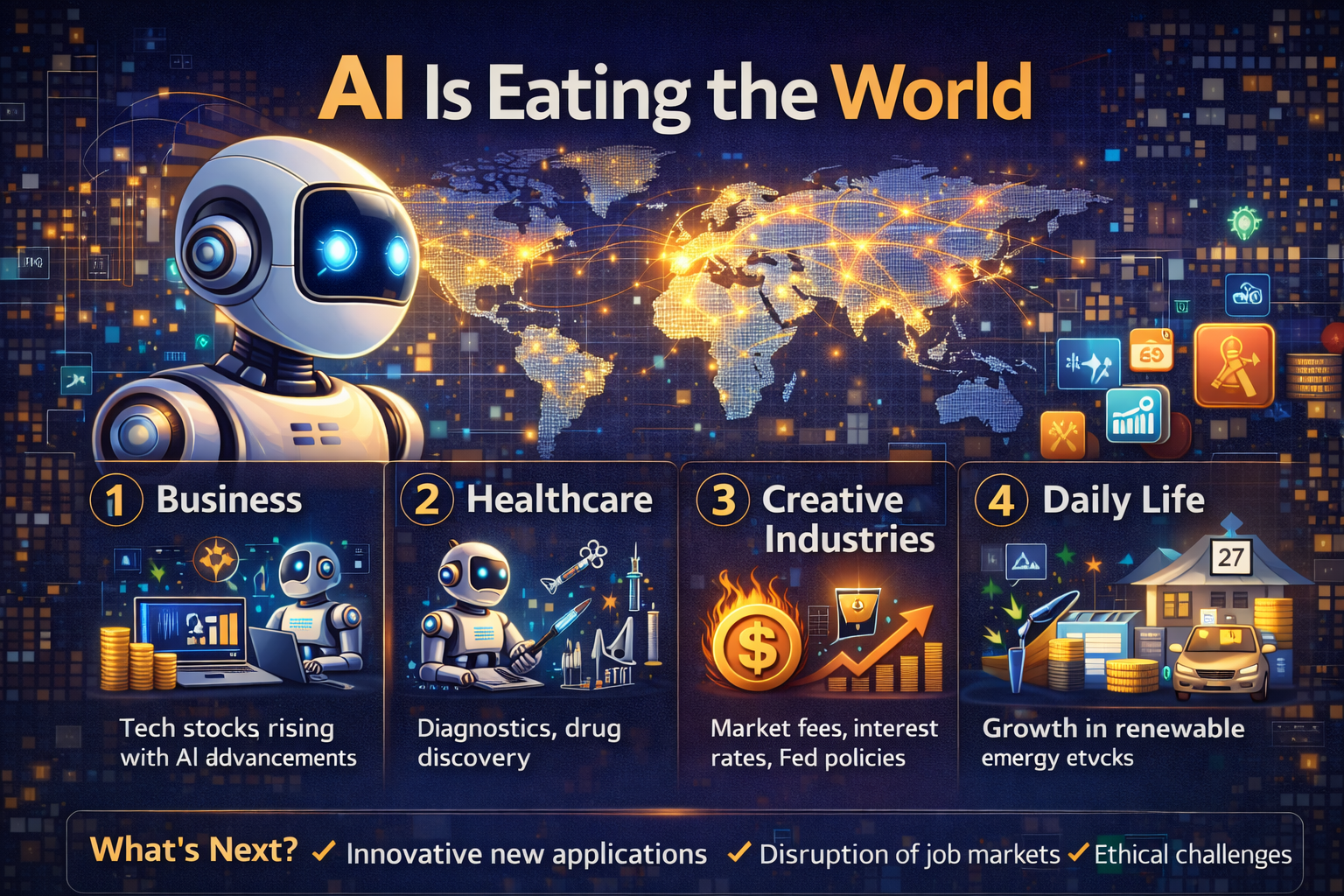
Marc Andreessen, the legendary venture capitalist, wrote an essay in 2011 that seemed absurd at the time. “Software is eating the world,” he declared. Most people thought he was exaggerating. Software was just something that ran on computers. How could it eat the world?
Fifteen years later, we know he was right. Software ate retail (Amazon), transportation (Uber), hospitality (Airbnb), media (Netflix), and countless other industries. The companies that didn’t adapt disappeared.
Now, a new essay needs to be written. AI is eating the world—and it’s happening faster than software ever did.
The difference is speed. It took software decades to disrupt industries. AI is doing it in years. Sometimes months. ChatGPT launched in November 2022. By January 2023, it had 100 million users. The fastest-growing consumer application in history. And that was just the beginning.
Today, AI is eating the world across every sector. Healthcare, finance, education, manufacturing, creative work, customer service, software development—no industry is immune. The question isn’t whether AI will transform your industry. It’s whether you’ll be ahead of the transformation or behind it.
In this guide, we’ll explore how AI is eating the world across 10 key domains. We’ll look at what’s happening now, what’s coming next, and what it means for you. Whether you’re a business leader, employee, entrepreneur, or just trying to understand the world, this guide will help you see the pattern.
Because AI is eating the world. And it’s only getting started.
Part 1: The Speed of Change
Before we dive into specific domains, let’s understand why AI is eating the world so quickly.
The Adoption Curve
| Technology | Years to Reach 100M Users |
|---|---|
| Telephone | 75 years |
| Electricity | 50 years |
| Radio | 38 years |
| Television | 22 years |
| Internet | 7 years |
| 4.5 years | |
| ChatGPT | 2 months |
AI adoption is unprecedented. It’s not replacing old technology—it’s creating entirely new capabilities.
The Cost Curve
| Task | Cost (2022) | Cost (2026) | Change |
|---|---|---|---|
| Generate 1,000 words of copy | $500 (human writer) | $0.10 (AI) | -99.98% |
| Label 1,000 images | $1,000 (human) | $10 (AI) | -99% |
| Translate 10,000 words | $1,000 (human) | $5 (AI) | -99.5% |
| Summarize a 100-page document | $500 (human) | $0.05 (AI) | -99.99% |
When the cost of a capability drops by 99%, everything changes. Tasks that were once impossible become routine. Tasks that were once expensive become free.
Part 2: How AI Is Eating Software
AI is eating the world starting with the software industry itself.
From Code to Natural Language
For decades, programming meant learning languages like Python, Java, or C++. You had to understand syntax, data structures, algorithms, and debugging. That’s changing.
| Capability | 2020 | 2026 |
|---|---|---|
| Write a function | Human wrote manually | AI generates from comment |
| Debug an error | Human reads stack trace | AI suggests fix |
| Document code | Human writes comments | AI generates automatically |
| Write tests | Human writes test cases | AI generates edge cases |
The Impact on Developers
| Skill | Importance (2020) | Importance (2026) |
|---|---|---|
| Syntax memorization | High | Low |
| Algorithm implementation | High | Medium (AI handles routine) |
| System architecture | Medium | High |
| Problem decomposition | Medium | High |
| Code review | Low | High |
| Prompt engineering | 0 | High |
The takeaway: AI is eating the world of software development, but not replacing developers. It’s shifting their focus from writing code to designing systems.
Part 3: How AI Is Eating Content Creation
AI is eating the world of words, images, video, and audio.
Written Content
| Content Type | AI Capability (2026) |
|---|---|
| Blog posts | AI generates first draft; human edits |
| Social media | AI generates entire calendar |
| Email marketing | AI personalizes at scale |
| SEO content | AI optimizes for search |
| Product descriptions | AI generates thousands instantly |
Visual Content
| Content Type | AI Capability (2026) |
|---|---|
| Logo design | AI generates dozens of options |
| Social graphics | AI creates from templates |
| Product photography | AI generates realistic images |
| Stock photos | AI generates custom images |
| Video thumbnails | AI tests multiple variations |
Video and Audio
| Content Type | AI Capability (2026) |
|---|---|
| Voiceover | AI clones any voice |
| Video editing | AI cuts, transitions, captions |
| Music composition | AI generates original tracks |
| Podcast production | AI removes filler words, adds intro/outro |
The takeaway: AI is eating the world of content creation, but human creativity remains essential for strategy, taste, and emotional connection.
Part 4: How AI Is Eating Customer Service
AI is eating the world of customer support.
Before AI
| Problem | Impact |
|---|---|
| Long wait times | Customer frustration |
| Inconsistent answers | Different reps give different information |
| Limited hours | 9-5 support only |
| High cost | Labor-intensive |
After AI
| Capability | Impact |
|---|---|
| 24/7 instant responses | No waiting |
| Consistent answers | Same knowledge base for all interactions |
| Personalized service | AI remembers customer history |
| Lower cost | 80% reduction in support costs |
The Numbers
| Metric | 2020 | 2026 |
|---|---|---|
| Chatbots handling tier-1 support | 25% | 75% |
| Average response time | 4 hours | 30 seconds |
| Support cost per ticket | $10 | $2 |
The takeaway: AI is eating the world of customer service, but human agents still handle escalations, complex issues, and emotional situations.
Part 5: How AI Is Eating Healthcare
AI is eating the world of medicine and diagnostics.
Diagnosis
| Condition | AI Capability (2026) |
|---|---|
| Lung cancer | Detects nodules radiologists might miss |
| Diabetic retinopathy | Matches ophthalmologist accuracy |
| Skin cancer | Analyzes images, suggests biopsy |
| Heart disease | Predicts risk from routine data |
Drug Discovery
| Phase | Traditional Timeline | AI-Enhanced Timeline |
|---|---|---|
| Target identification | 2-3 years | 3-6 months |
| Lead optimization | 3-5 years | 6-12 months |
| Preclinical testing | 1-2 years | 3-6 months |
| Total | 10-15 years | 2-4 years |
Administrative
| Task | AI Impact |
|---|---|
| Clinical documentation | 70% reduction in physician time |
| Insurance prior authorization | 90% faster |
| Appointment scheduling | Fully automated |
| Medical coding | AI suggests codes, human reviews |
The takeaway: AI is eating the world of healthcare, but doctors remain essential for diagnosis, treatment decisions, and patient relationships.
Part 6: How AI Is Eating Education
AI is eating the world of learning.
Personalized Learning
| Traditional | AI-Enhanced |
|---|---|
| One curriculum for all | Adapts to each student’s pace |
| Same examples for everyone | Examples tailored to student interests |
| Teacher-centered | Student-centered |
| One-size-fits-all homework | Personalized practice |
AI Tutors
| Capability | Benefit |
|---|---|
| 24/7 availability | Students can learn anytime |
| Infinite patience | Never tires of explaining |
| Adaptive difficulty | Always at the right level |
| Instant feedback | No waiting for grading |
The Numbers
| Metric | 2020 | 2026 |
|---|---|---|
| Students using AI tutors | 5% | 60% |
| Teachers using AI for lesson planning | 10% | 80% |
| Schools with AI-powered personalized learning | 2% | 40% |
The takeaway: AI is eating the world of education, but teachers remain essential for motivation, mentorship, and human connection.
Part 7: How AI Is Eating Finance
AI is eating the world of money.
Trading
| Approach | 2020 | 2026 |
|---|---|---|
| Human-driven trading | 60% | 30% |
| Algorithmic trading | 40% | 70% |
| AI-driven trading | 10% | 40% |
Fraud Detection
| Metric | Without AI | With AI |
|---|---|---|
| Detection rate | 50% | 95% |
| False positives | 10% | 1% |
| Response time | Hours | Milliseconds |
Personal Finance
| Capability | AI Impact |
|---|---|
| Budgeting | AI categorizes spending automatically |
| Investing | Robo-advisors manage portfolios |
| Tax preparation | AI finds deductions humans miss |
| Credit scoring | AI uses alternative data |
The takeaway: AI is eating the world of finance, but human judgment remains essential for strategy, risk management, and client relationships.
Part 8: How AI Is Eating Manufacturing
AI is eating the world of factories and supply chains.
Predictive Maintenance
| Metric | Traditional | AI-Enhanced |
|---|---|---|
| Unplanned downtime | 10-20% of production time | 2-5% |
| Maintenance costs | Baseline | 30-50% lower |
| Equipment lifespan | Standard | 20-30% longer |
Quality Control
| Metric | Human Inspection | AI Vision |
|---|---|---|
| Defect detection rate | 80% | 99.5% |
| Speed | 100 units/hour | 1,000+ units/hour |
| Consistency | Varies by shift | Perfect |
Supply Chain
| Capability | AI Impact |
|---|---|
| Demand forecasting | 50% more accurate |
| Inventory optimization | 30% lower inventory |
| Route planning | 20% fuel savings |
The takeaway: AI is eating the world of manufacturing, but humans remain essential for maintenance, problem-solving, and continuous improvement.
Part 9: How AI Is Eating Creative Work
AI is eating the world of art, design, and creativity.
Visual Arts
| Art Form | AI Capability |
|---|---|
| Illustration | Generate original images from text prompts |
| Graphic design | Create layouts, suggest color palettes |
| Photography | Edit, retouch, enhance |
| Architecture | Generate building designs |
Music
| Music Form | AI Capability |
|---|---|
| Composition | Generate original melodies |
| Production | Mix, master, add effects |
| Lyrics | Write verses, rhymes |
| Performance | Clone any voice or instrument |
Writing
| Writing Form | AI Capability |
|---|---|
| Poetry | Generate in any style |
| Fiction | Outline plots, write scenes |
| Screenplays | Format, suggest dialogue |
| Journalism | Summarize data, write reports |
The takeaway: AI is eating the world of creative work, but human creativity remains essential for taste, intention, and emotional resonance.
Part 10: How AI Is Eating the Workforce
AI is eating the world of jobs.
Jobs Most Exposed
| Job Category | % of Tasks Automatable | Timeline |
|---|---|---|
| Data entry | 90% | Already happening |
| Translation | 85% | Already happening |
| Copywriting | 70% | 1-3 years |
| Accounting | 65% | 3-5 years |
| Customer service | 60% | Already happening |
| Legal research | 55% | 3-5 years |
Jobs Least Exposed
| Job Category | % of Tasks Automatable | Why |
|---|---|---|
| Healthcare (doctors, nurses) | 20% | Human touch, complex decisions |
| Education (teachers) | 25% | Mentorship, motivation |
| Management | 30% | Strategy, people skills |
| Creative direction | 35% | Taste, vision |
| Trades (electricians, plumbers) | 40% | Physical manipulation |
The Pattern
| Role | Before AI | After AI |
|---|---|---|
| Junior employee | Did routine work to learn | AI handles routine; junior employees learn through different methods |
| Senior employee | Managed juniors, did complex work | Focuses on strategy, judgment, exceptions |
| Entry-level | Scarcity of opportunities | New types of entry-level roles emerge |
The takeaway: AI is eating the world of jobs, but it’s creating new roles, shifting skills, and increasing the value of uniquely human capabilities.
Part 11: What AI Cannot Eat
Despite the headline, AI is eating the world has limits. Here’s what AI cannot do.
Human-Only Capabilities
| Capability | Why AI Can’t Replace |
|---|---|
| Taste | AI can generate options; humans choose what’s good |
| Intention | AI has no goals; humans set direction |
| Empathy | AI can simulate; humans genuinely feel |
| Judgment | AI can analyze; humans weigh trade-offs |
| Creativity | AI can recombine; humans create ex nihilo |
| Accountability | AI can’t take responsibility |
The Human Role in an AI World
| Activity | Human Role |
|---|---|
| Strategy | Set direction, make trade-offs |
| Ethics | Define values, enforce boundaries |
| Relationships | Build trust, provide empathy |
| Taste | Curate, approve, reject |
| Judgment | Decide when AI is wrong |
Part 12: How to Survive and Thrive
If AI is eating the world, how do you stay relevant?
For Individuals
| Skill | Why It Matters |
|---|---|
| Prompt engineering | Directing AI effectively |
| Critical thinking | Evaluating AI outputs |
| Creativity | Generating novel ideas |
| Emotional intelligence | Human connection |
| Adaptability | Learning new tools quickly |
For Businesses
| Strategy | Why It Matters |
|---|---|
| Embed AI everywhere | Efficiency is competitive advantage |
| Redesign roles | Humans focus on judgment, not routine |
| Train continuously | Skills will need constant updating |
| Experiment aggressively | What works today may not work tomorrow |
Conclusion
Let’s bring this together.
AI is eating the world—and that’s not a threat. It’s an opportunity.
The same technologies that are automating routine tasks are also augmenting human capabilities. The same AI that can write a blog post can also help a doctor diagnose disease. The same AI that can generate art can also help an architect design a building.
The question isn’t whether AI is eating the world. It’s whether you’ll be eaten or whether you’ll learn to digest it.
The winners in this new world won’t be those who resist AI. They’ll be those who embrace it, learn to use it, and focus on what only humans can do: strategy, judgment, creativity, empathy, and connection.
AI is eating the world. But there’s plenty of room at the table for humans who know how to serve themselves.






Leave a Reply