I walked into a warehouse last month that looked nothing like the warehouses I remembered. No clipboard-wielding supervisors. No frantic searching for misplaced inventory. No stacks of paper forms. Instead, a fleet of small autonomous robots glided silently through aisles, scanning barcodes and updating inventory in real time. A manager sat at a desk with a tablet, watching a dashboard that predicted—before the end of the day—which products would need reordering by week’s end.
When I asked how long it took to implement this system, the manager shrugged. “Six months. And it paid for itself in the first year.”
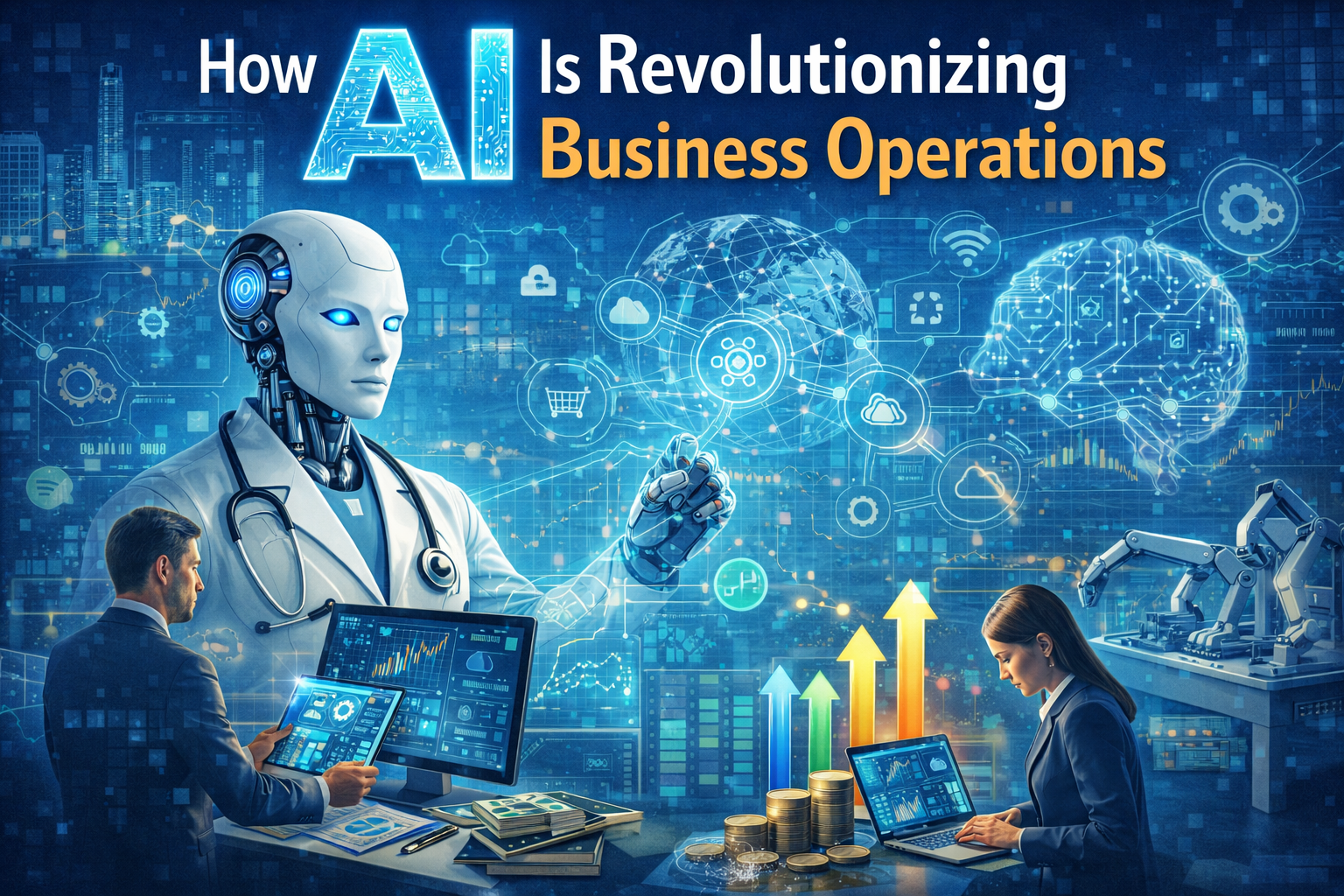
This is the quiet revolution of AI revolutionizing business operations. It’s not the flashy AI of self-driving cars or humanoid robots. It’s the invisible AI that optimizes supply chains, automates customer service, predicts equipment failures, and surfaces insights from oceans of data. It’s AI that doesn’t replace jobs but transforms them—freeing people to do work that actually requires human judgment.
The numbers are staggering. According to McKinsey, companies that fully integrate AI into their operations see profit margins increase by 5-15% within three years . Gartner predicts that by 2026, 75% of enterprises will have operationalized AI in their core business processes . And Deloitte found that organizations using AI in operations report 50% faster decision-making .
In this guide, we’ll explore AI revolutionizing business operations across every function—from supply chain and customer service to finance and human resources. We’ll look at real-world examples, practical implementation strategies, and the pitfalls to avoid. Whether you’re a business leader, manager, or entrepreneur, this guide will give you a roadmap for harnessing AI to make your operations smarter, faster, and more resilient.
Let’s dive in.
Part 1: The Evolution of Business Operations
Before we explore AI revolutionizing business operations, we need to understand where we started.
The Three Eras of Business Operations
| Era | Time Period | Characteristics |
|---|---|---|
| Manual Era | Pre-1980s | Paper-based processes, human judgment, slow decision-making |
| Digital Era | 1980s-2010s | Computerized systems, databases, basic analytics, still human-heavy |
| Intelligent Era | 2020s-present | AI-driven processes, predictive analytics, autonomous systems, human oversight |
We’re currently in the Intelligent Era. The shift isn’t incremental—it’s fundamental. Instead of using software to document what happened, we’re using AI to predict what will happen. Instead of humans executing routine tasks, AI handles them while humans focus on exceptions and strategy. This is the essence of AI revolutionizing business operations.
Why Now?
Several factors have converged to accelerate AI in business operations:
- Data abundance: Companies now generate massive amounts of operational data from sensors, transactions, customer interactions, and supply chains
- Cloud computing: Scalable, affordable computing power makes AI accessible to businesses of all sizes
- AI maturity: Algorithms have evolved from experimental to production-ready
- Workforce pressures: Labor shortages and rising costs make automation increasingly attractive
- Competitive pressure: Early adopters are gaining advantages that competitors can’t ignore
Part 2: AI in Supply Chain and Logistics
Supply chain is where AI revolutionizing business operations is perhaps most visibly transforming industries.
Demand Forecasting
Traditional demand forecasting relies on historical sales data and human judgment. AI adds layers of sophistication: analyzing weather patterns, economic indicators, social media trends, and even competitor activity to predict demand with unprecedented accuracy.
Real-world example: Walmart uses AI to predict demand for 100 million SKUs across 4,700 stores. The system analyzes local events, weather forecasts, and historical patterns to ensure the right products are in the right places at the right times. Result: 15% reduction in out-of-stocks and 10% reduction in excess inventory .
Inventory Optimization
AI doesn’t just predict what customers will buy—it tells you where to put it. Algorithms can optimize inventory placement across warehouses and stores, minimizing shipping costs and delivery times.
Practical tip: Start with your top 20% of SKUs (the ones driving 80% of revenue). Implementing AI inventory optimization for these products can deliver 80% of the benefit with much less complexity.
Warehouse Automation
Autonomous mobile robots (AMRs) are transforming warehouses. Unlike traditional automated guided vehicles that follow fixed paths, AMRs use AI to navigate dynamic environments, avoiding obstacles and optimizing routes in real time.
Amazon’s fulfillment centers now use over 750,000 robots that work alongside human employees. The robots bring shelves to workers, reducing walking time and increasing picking efficiency by up to 300% .
Predictive Maintenance
Equipment failures are expensive. Unplanned downtime costs industrial manufacturers an estimated $50 billion annually . AI can predict when equipment is likely to fail by analyzing vibration data, temperature readings, and operational patterns.
Real-world example: Siemens uses AI to predict failures in gas turbines. The system analyzes data from 10,000 sensors per turbine, identifying subtle patterns that precede failure. The result: 30% reduction in unplanned downtime and significant cost savings.
Part 3: AI in Customer Operations
Customer operations—support, service, and engagement—is perhaps the most visible application of AI revolutionizing business operations.
AI-Powered Customer Support
AI chatbots have evolved from frustrating menu trees to sophisticated conversational agents. Modern AI support systems can:
- Understand natural language and intent
- Access customer history and context
- Resolve common issues without human intervention
- Escalate complex issues with full context
The numbers: Gartner predicts that by 2026, AI will handle 75% of customer service interactions, up from 25% in 2023 . Companies using AI support report 30-40% reduction in support costs and 20-30% improvement in response times.
Real-world example: Bank of America’s virtual assistant, Erica, has handled over 1.5 billion client interactions since launch, handling everything from balance inquiries to fraud detection .
Sentiment Analysis
AI can analyze customer feedback across channels—emails, social media, reviews, surveys—to identify emerging issues before they escalate. Natural language processing (NLP) algorithms can detect frustration, urgency, and satisfaction levels, flagging at-risk customers for proactive outreach.
Practical tip: Don’t just analyze complaints. Analyze what customers love. AI can identify patterns in positive feedback that reveal your competitive advantages—insights you can double down on.
Personalization at Scale
AI enables personalized experiences for millions of customers simultaneously. Recommendation engines, dynamic pricing, and personalized marketing messages all use AI to tailor experiences to individual preferences.
Real-world example: Netflix’s recommendation engine saves the company an estimated $1 billion annually by reducing churn. Every user sees a personalized homepage, with AI analyzing viewing history, time of day, device, and even what other users with similar tastes are watching.
Part 4: AI in Marketing and Sales
Marketing and sales teams are leveraging AI revolutionizing business operations to become more efficient and effective.
Lead Scoring and Prioritization
Not all leads are created equal. AI can analyze thousands of data points—website behavior, email engagement, firmographic data, past purchase patterns—to predict which leads are most likely to convert. Sales teams can focus on high-probability opportunities instead of cold calling lists.
Real-world example: HubSpot’s AI-powered lead scoring helps sales teams prioritize leads, resulting in 30% higher conversion rates .
Content Generation
AI writing assistants are transforming content marketing. Tools like Jasper, Copy.ai, and ChatGPT can generate blog posts, social media content, email campaigns, and ad copy at scale.
Important caveat: AI-generated content should be reviewed and refined by humans. The best approach uses AI for first drafts and outlines, with human editors adding voice, nuance, and expertise.
Ad Optimization
AI can manage ad campaigns across platforms, automatically adjusting bids, targeting, and creative based on real-time performance data. This frees marketers from manual optimization and often outperforms human management.
Real-world example: Persado, an AI marketing platform, generated a 49% higher click-through rate for a major bank by using AI to generate and optimize email subject lines .
Part 5: AI in Finance and Accounting
Finance functions are increasingly embracing AI revolutionizing business operations to improve accuracy and efficiency.
Accounts Payable and Receivable
AI can automate invoice processing, extracting data from scanned documents, matching purchase orders, and routing approvals. The result: faster processing, fewer errors, and reduced fraud risk.
Real-world example: KPMG reports that AI-powered accounts payable automation reduces processing costs by up to 80% and cuts processing time from days to hours .
Expense Management
AI can analyze expense reports, flagging policy violations and potential fraud. Machine learning models learn what normal spending looks like and identify anomalies for review.
Financial Forecasting
Traditional financial forecasting relies on spreadsheets and historical data. AI adds predictive analytics, incorporating external data like economic indicators, industry trends, and even weather patterns to improve forecast accuracy.
Practical tip: Start with cash flow forecasting. AI can help predict cash needs with greater accuracy, reducing the need for emergency financing or the cost of excess cash reserves.
Audit and Compliance
AI can analyze entire datasets rather than samples, identifying anomalies that might indicate fraud or compliance issues. Continuous monitoring replaces periodic audits, catching issues in real time.
Part 6: AI in Human Resources
HR is being transformed by AI revolutionizing business operations across the employee lifecycle.
Recruitment and Screening
AI can screen thousands of resumes, identifying candidates whose skills and experience match job requirements. More sophisticated tools can assess candidate fit through video interviews, analyzing language, tone, and even facial expressions.
Important consideration: AI screening tools must be carefully audited for bias. Tools trained on historical hiring data may perpetuate past discrimination. Regular testing and human oversight are essential.
Employee Engagement
AI can analyze employee communications, survey responses, and performance data to identify engagement risks before they lead to turnover. Predictive models can flag employees likely to leave, enabling proactive retention efforts.
Learning and Development
AI can recommend personalized learning paths based on employee skills, career goals, and business needs. Instead of one-size-fits-all training, employees receive curated content relevant to their roles.
Real-world example: IBM uses AI to power its learning platform, which has reduced the time employees spend searching for learning content by 50% .
Part 7: AI in IT Operations
IT operations are increasingly AI-driven, with systems that monitor, diagnose, and even fix issues autonomously.
AIOps (AI for IT Operations)
AIOps platforms aggregate data from monitoring tools, logs, and alerts, using AI to identify patterns, correlate events, and predict incidents before they impact users.
Real-world example: A major financial institution using AIOps reduced incident response time from 2 hours to 15 minutes and prevented 30% of incidents before they affected customers .
Security Operations
AI-powered security tools can analyze network traffic, user behavior, and threat intelligence to detect and respond to threats in real time. This is essential given the volume of alerts that human analysts can’t possibly process.
The numbers: The average organization receives 10,000 security alerts daily—far more than human teams can investigate. AI triage can reduce this to a manageable number, prioritizing genuine threats.
Infrastructure Optimization
AI can optimize cloud resource allocation, automatically scaling infrastructure up or down based on demand. This reduces costs while ensuring performance.
Part 8: Implementation Strategies
Knowing AI revolutionizing business operations is one thing. Implementing it is another. Here’s how to succeed.
Start with the Right Problems
Not every process should be automated. Focus on:
- High-volume, repetitive tasks: These deliver the biggest ROI
- Data-rich processes: AI needs data to learn
- Processes with clear metrics: You need to measure improvement
- Pain points: Where are your bottlenecks? Your most frustrated employees?
Build a Data Foundation
AI is only as good as the data it’s trained on. Before implementing AI:
- Clean existing data (remove duplicates, fix errors)
- Structure unstructured data where possible
- Ensure data is accessible across silos
- Establish data governance (who owns data quality?)
Start Small, Then Scale
The most successful AI implementations follow a pattern:
- Pilot: Pick one process, one team, measure results
- Learn: What worked? What didn’t? What would you do differently?
- Expand: Apply learnings to another process
- Scale: Once you’ve proven the model, roll out broadly
Practical tip: Choose a pilot with clear metrics and a quick feedback loop. Aim for results within 3 months. Early wins build momentum and budget for broader initiatives.
Involve the People
AI implementations fail when they ignore the humans who will use them.
- Involve front-line employees in design and testing
- Be transparent about what AI will and won’t do
- Invest in training and change management
- Redesign roles, don’t just automate tasks
Build vs. Buy
Not every AI solution needs to be custom-built. Evaluate:
| Option | Best For | Examples |
|---|---|---|
| Off-the-shelf SaaS | Common use cases with established solutions | Salesforce Einstein, HubSpot AI, Zendesk AI |
| Platform tools | Customization with low-code | AWS AI services, Google Cloud AI, Microsoft Azure AI |
| Custom development | Unique competitive advantage | Proprietary models for your specific business |
Part 9: Measuring Success
How do you know if AI revolutionizing business operations is working? Track these metrics.
| Category | Metrics |
|---|---|
| Efficiency | Cycle time reduction, cost per transaction, throughput increase |
| Quality | Error rate reduction, consistency, compliance improvements |
| Employee impact | Time freed for higher-value work, employee satisfaction, turnover |
| Customer impact | Response time, resolution rate, customer satisfaction scores |
| Financial | ROI, payback period, profit margin improvement |
Practical tip: Establish baseline metrics before implementation. You need to know where you started to measure improvement.
Part 10: Challenges and Risks
For all its promise, AI revolutionizing business operations comes with real challenges.
Data Quality and Availability
AI models are only as good as their training data. If your data is messy, incomplete, or biased, your AI will reflect those problems.
Mitigation: Invest in data governance. Clean your data before training models. Test models on diverse datasets to identify bias.
Integration Complexity
AI systems need to work with existing systems—ERPs, CRMs, databases. Integration is often the hardest part of implementation.
Mitigation: Prioritize platforms with strong APIs and pre-built integrations. Consider middleware tools to connect systems.
Talent Gaps
AI talent is expensive and scarce. Many organizations lack the skills to develop, implement, and maintain AI systems.
Mitigation: Start with no-code/low-code AI tools. Partner with vendors who provide implementation support. Invest in upskilling existing employees.
Change Management
AI changes how people work. Without careful change management, employees may resist or sabotage implementation.
Mitigation: Involve employees early. Communicate transparently about what’s changing and why. Invest in training. Redesign roles to highlight new opportunities.
Ethical Concerns
AI systems can perpetuate bias, invade privacy, and make decisions that affect people’s lives.
Mitigation: Establish AI ethics guidelines. Audit models for bias before deployment. Maintain human oversight for consequential decisions. Be transparent with customers about AI use.
Part 11: The Future of AI in Business Operations
What’s next for AI revolutionizing business operations?
Autonomous Operations
We’re moving toward operations that run autonomously, with humans overseeing rather than executing. In a truly autonomous supply chain, AI would predict demand, place orders, route shipments, and handle exceptions—all without human intervention.
Generative AI for Operations
Generative AI will move beyond content creation to operational applications. Imagine AI that generates custom workflows for new business processes, creates documentation automatically, or produces training materials tailored to individual employees.
Agentic AI
AI agents—systems that can pursue goals independently—will transform operations. Instead of separate AI tools for forecasting, inventory, and logistics, integrated agents will manage entire functions collaboratively.
Democratization
Low-code and no-code AI tools will make AI accessible to business users, not just data scientists. Operations managers will be able to build their own AI solutions without writing code.
Conclusion
Let’s bring this together.
AI revolutionizing business operations is not a distant promise—it’s happening now, across supply chains, customer service centers, marketing departments, finance teams, and HR functions. It’s not replacing human judgment; it’s amplifying it. The organizations that thrive will be those that embrace AI not as a technology project but as a strategic transformation.
The opportunity is enormous. Companies fully integrating AI into operations see profit margins increase 5-15%. They make decisions 50% faster. They free employees from drudgery to focus on work that requires uniquely human capabilities.
But the window is closing. Early adopters are building advantages that latecomers will struggle to match. The question isn’t whether AI will transform business operations—it’s whether your organization will lead or follow.
The technology is here. The tools are accessible. The playbook is proven. Now it’s time to act.