Picture this: you’re launching a startup. You have a killer idea, but your funding is… well, let’s call it “aspirational.” The classic playbook says you need a co-founder, a developer, a marketer, and an accountant. Your bank account says otherwise.
Now, imagine a different path. What if your first hire wasn’t a person, but a collection of intelligences? An AI agent that writes your code, another that designs your website, a third that drafts your marketing copy, and a digital assistant that manages your books. This isn’t science fiction. It’s the emerging reality of the AI-powered startup—a venture that challenges our deepest assumptions about what it means to build a company.
The question in our title—”Building a Business with No Employees?”—isn’t just a catchy hook. It’s a serious exploration of the new frontier of entrepreneurship. Can you truly build a scalable, valuable business without a traditional team? The short answer is: not exactly, but the definition of “team” is changing faster than we ever imagined.
I’ve spent the last year talking to founders who are pushing these boundaries. They’re not just using ChatGPT for brainstorming. They’re constructing automated workflows where AI agents handle 80% of the operational grind, freeing them to focus on strategy, creativity, and the human connections that machines can’t replicate. This post isn’t about replacing people. It’s about reimagining leverage. We’ll dissect the promise, the very real pitfalls, and provide a practical blueprint for how you can use today’s AI tools to build something remarkable with resources that would have been unthinkable a decade ago. Welcome to the future of starting up.

The Dream vs. The Reality: What “No Employees” Really Means
Let’s be brutally honest: the vision of a fully autonomous, self-running business generating millions while you sip a cocktail on the beach is mostly a fantasy. AI is not a sentient CEO. The “No Employees” model isn’t about complete absence of human involvement; it’s about a radical shift in the type of human work required.
- The Dream: A single prompt creates a perfect, fully-functional company.
- The Reality: A single founder acts as a conductor and curator, orchestrating a symphony of specialized AI tools and occasional freelance human experts.
The real promise here is the exponential increase in individual leverage. One person can now manage what used to require five. This model is perfectly suited for specific types of ventures:
- Digital Products & SaaS: Subscription tools, online courses, downloadable software.
- Content & Media Businesses: Niche newsletters, automated blogs, curated video channels.
- Agency & Service Models (with a twist): Design, writing, or marketing services delivered via an AI-augmented, founder-led process.
- E-commerce & Dropshipping: Highly automated storefronts with AI-driven marketing and customer service.
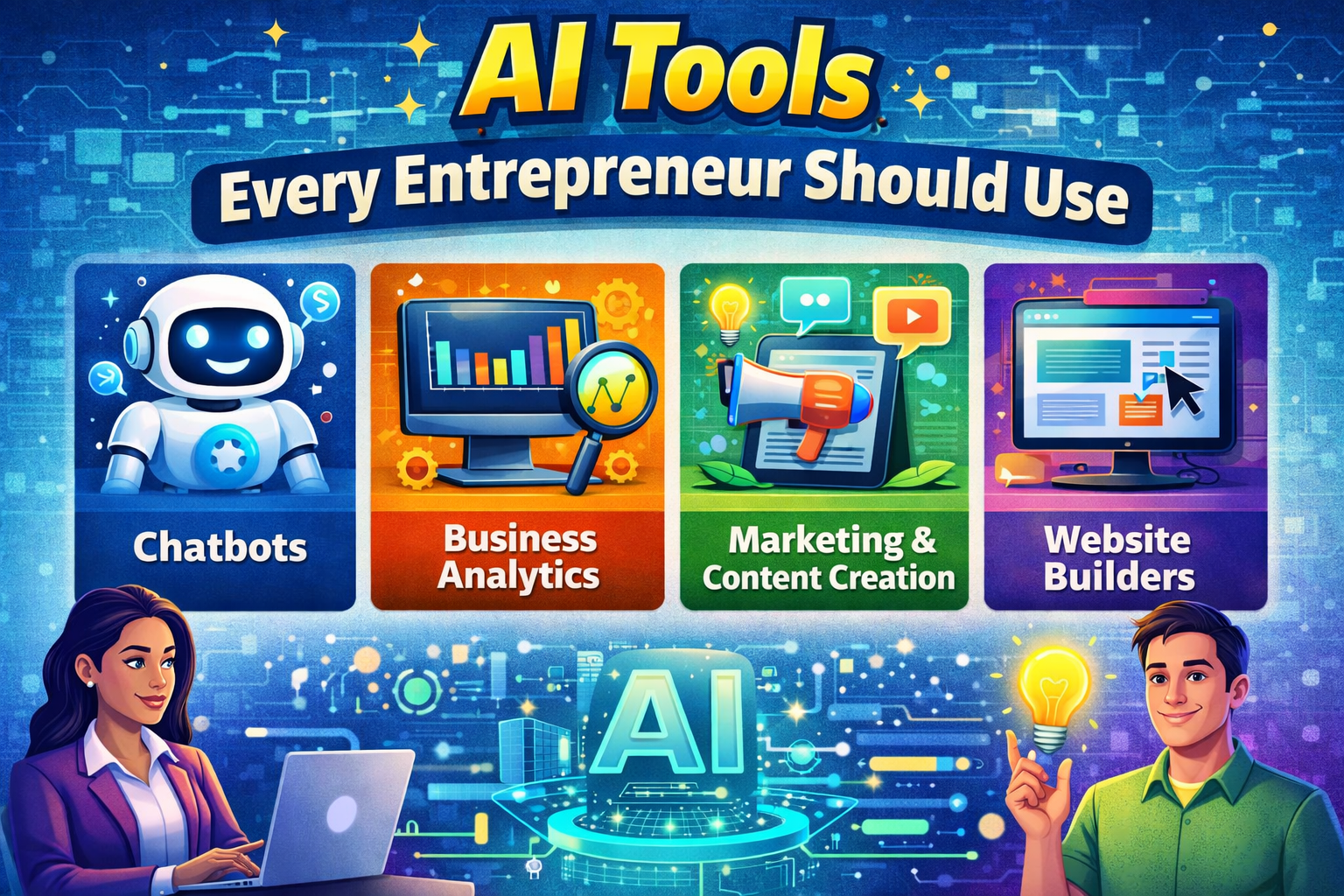
The AI “Team”: Mapping Tools to Business Functions
You’re the founder-CEO. Here’s who’s on your AI-powered bench. Think of these not as employees, but as incredibly capable, on-demand contractors.
1. Your CTO: Development & Product AI
Building a digital product no longer always means writing every line of code yourself.
- The Tools: GitHub Copilot, Replit AI, Cursor, and advanced ChatGPT/Claude for code generation.
- In Practice: You describe a feature in plain English—”a user dashboard that shows login history and project count.” Your AI pair-programmer suggests the code structure, writes boilerplate functions, and debugs errors when you paste in the traceback. For no-code solutions, tools like Bubble or Softr have AI integrated to generate app logic and workflows from descriptions.
- The Founder’s Role: You must provide crystal-clear, detailed specifications and have enough technical understanding to vet the output, ensure security, and guide the architecture. You’re the product manager and QA lead.
2. Your Creative Department: Content & Design AI
From your logo to your blog to your ad copy, AI can generate the first draft of nearly everything.
- The Tools: For design, Midjourney, DALL-E 3, and Canva AI. For copy, Claude for long-form, ChatGPT for variety, and Grammarly or Writer for polish.
- In Practice: Prompt: “Create a minimalist, friendly logo for a startup called ‘Bloom Budget’ that helps young adults save money. Use colors blue and green.” You’ll get dozens of options in minutes. For a blog post, you can feed an AI an outline and a key insight, and it will produce a solid 1,000-word draft for you to personalize.
- The Founder’s Role: You are the creative director. AI is a prolific junior designer and writer. Your value is in the taste, the brand voice, the strategic edit, and the final approval. You prompt, curate, and refine.
3. Your Marketing & Sales Team
This is where AI shines at scale and personalization.
- The Tools: Jasper for campaign copy, Copy.ai for ads, HubSpot’s AI for CRM insights, PhantomBuster for automated outreach, and ChatGPT for analyzing customer feedback.
- In Practice: You can train an AI on your customer testimonials and product details, then have it generate hundreds of personalized cold email variants for different buyer personas. Social media management tools like Buffer or Hootsuite use AI to suggest optimal posting times and content.
- The Founder’s Role: You set the strategy, define the target audience, and handle the high-touch, closing conversations. AI handles the broad-scale top-of-funnel generation and lead qualification.
4. Your Operations & Support “Department”
The grind of admin, bookkeeping, and customer support is prime for automation.
- The Tools: Zapier or Make.com to connect everything (your “AI integrator”), QuickBooks AI for accounting categorization, and sophisticated AI chatbots like Intercom’s Fin or Zendesk Answer Bot for tier-1 support.
- In Practice: A customer email about a password reset can be handled entirely by an AI support agent. An invoice hitting your inbox can be auto-processed into your accounting software. A new lead from your website can trigger a personalized welcome sequence without you lifting a finger.
- The Founder’s Role: You build and maintain the automation workflows (the “pipes”) and step in for complex, sensitive, or high-value operational issues and support escalations.
The Inescapable Human Element: Where AI Falls Short
This is the most critical part of the blueprint. Ignoring these limitations will doom your “no-employee” venture.
- Strategic Vision & Juxtaposition: AI is brilliant at combining known ideas. It is not (yet) capable of the wild, intuitive leap that creates a truly novel product or business model. That “aha!” moment is yours alone.
- Empathy & High-Stakes Relationships: Negotiating a pivotal partnership, calming an angry VIP customer, or inspiring an early evangelist requires human emotional intelligence. AI can prepare you for the conversation, but it can’t have it.
- Ethical Judgment & Brand Soul: Every decision has a moral and brand dimension. Should we issue that refund? How do we handle this sensitive data issue? The “why” behind your business must be human.
- Quality Control & Cohesion: AI can produce content, but a cohesive brand voice across all touchpoints requires a human editor. AI can write code, but a secure, elegant, scalable system needs human oversight.
Your role evolves from “doer of tasks” to “orchestrator, curator, and connector.” You become the quality filter, the strategic brain, and the human face of the business.
A Practical Blueprint: Your 12-Month Roadmap to an AI-Leveraged Startup
Here’s how to translate this concept into action, phase by phase.
Phase 1: The Solopreneur Incubation (Months 1-3)
- Goal: Validate your idea and build the core MVP, just you and AI.
- Action: Use AI for market research (analyze forums, summarize trends), create your initial brand assets (logo, website copy with AI + a template like Carrd or Framer), and build a simple, functional prototype of your product using no-code or AI-assisted code.
- Mindset: “I am learning to direct my AI tools. Speed and validation are key.”
Phase 2: The Automated System (Months 4-6)
- Goal: Systematize operations. Remove yourself from repetitive loops.
- Action: Map out your key customer journeys. Use Zapier to automate lead capture > welcome email > feedback survey. Implement an AI chatbot for basic FAQs. Set up automated financial reporting.
- Mindset: “I am building a machine that can run without my constant input.”
Phase 3: The Strategic Human Layer (Months 7-12)
- Goal: Scale impact by adding targeted human expertise.
- Action: This is where you strategically break the “no employees” rule. You don’t hire a full-time developer; you hire a freelance dev on a contract to review and harden the AI-generated code for your v2.0. You don’t hire a content team; you hire a brilliant editor to polish and give soul to your AI-drafted articles. You are using capital to buy high-level human judgment to elevate the AI’s work.
- Mindset: “I am a CEO using AI for execution and humans for wisdom, creativity, and trust.”
The Financial & Legal Reality Check
- Cost: Your “AI team” isn’t free. Budget for subscriptions to premium AI tools ($100-$500/month), no-code platforms, and cloud hosting. It’s still orders of magnitude cheaper than salaries, but it’s not zero.
- Ownership & IP: Be vigilant. Who owns the AI-generated logo? The code? Terms of service vary. For critical assets, you may need a human-created final element or to use platforms with clear commercial rights. Consult a lawyer to understand the risks.
- Liability: If your AI customer service agent gives dangerously wrong advice, you are liable. You must build oversight and disclaimers into automated systems.
Conclusion
So, can you build a business with no employees? The pure, unadulterated version is more myth than reality—for now. But can you build a highly scalable, impactful, and profitable venture where AI does the heavy lifting of execution and you provide the irreplaceable human elements of vision, judgment, and connection? Absolutely.
The AI-powered startup isn’t about the absence of people. It’s about the strategic amplification of one person’s capabilities. It democratizes entrepreneurship, lowering the barrier to entry not by making things easy, but by making them possible with fewer resources.
The most successful founders of this new era won’t be the best coders or the slickest salespeople. They will be the best orchestrators—individuals who can brilliantly direct a chorus of artificial intelligence, seamlessly integrate targeted human expertise, and apply their own unique strategic and creative spark to the mix. They understand that AI is the ultimate leverage, but humanity is the ultimate differentiator.
Your challenge isn’t to replace yourself with machines. It’s to use machines to free yourself to do the work that only a human can do. That’s how you build a business that’s not just automated, but truly resilient, adaptive, and remarkable.