

A few years ago, artificial intelligence felt like science fiction. It was something that existed in research labs and tech company headquarters—interesting, but not particularly relevant to daily life. Ask someone on the street about AI in 2020, and they might have mentioned a chess-playing computer or a sci-fi movie.
Today, that same person interacts with AI dozens of times before lunch. It’s in the phone in their pocket, the recommendations on their streaming services, the emails in their inbox, and the navigation system in their car. AI has quietly become the infrastructure underneath modern life—so pervasive that we barely notice it anymore. These real-world applications of artificial intelligence have transformed how we live, work, and connect with one another.
The shift has been remarkably fast. In just a few years, we’ve moved from “Can AI do impressive things?” to “What can’t AI do?” The real-world applications of artificial intelligence now span nearly every industry and activity. Healthcare, transportation, finance, education, entertainment—all have been transformed by AI’s ability to recognize patterns, process language, and make predictions at scale.
What’s fascinating is how many of these AI applications in the real world have become invisible. We don’t think about AI when our email provider filters spam, when our bank flags a suspicious transaction, or when our thermostat adjusts itself. We just notice that things work better. The practical uses of artificial intelligence have become so integrated into daily life that they’ve disappeared into the background.
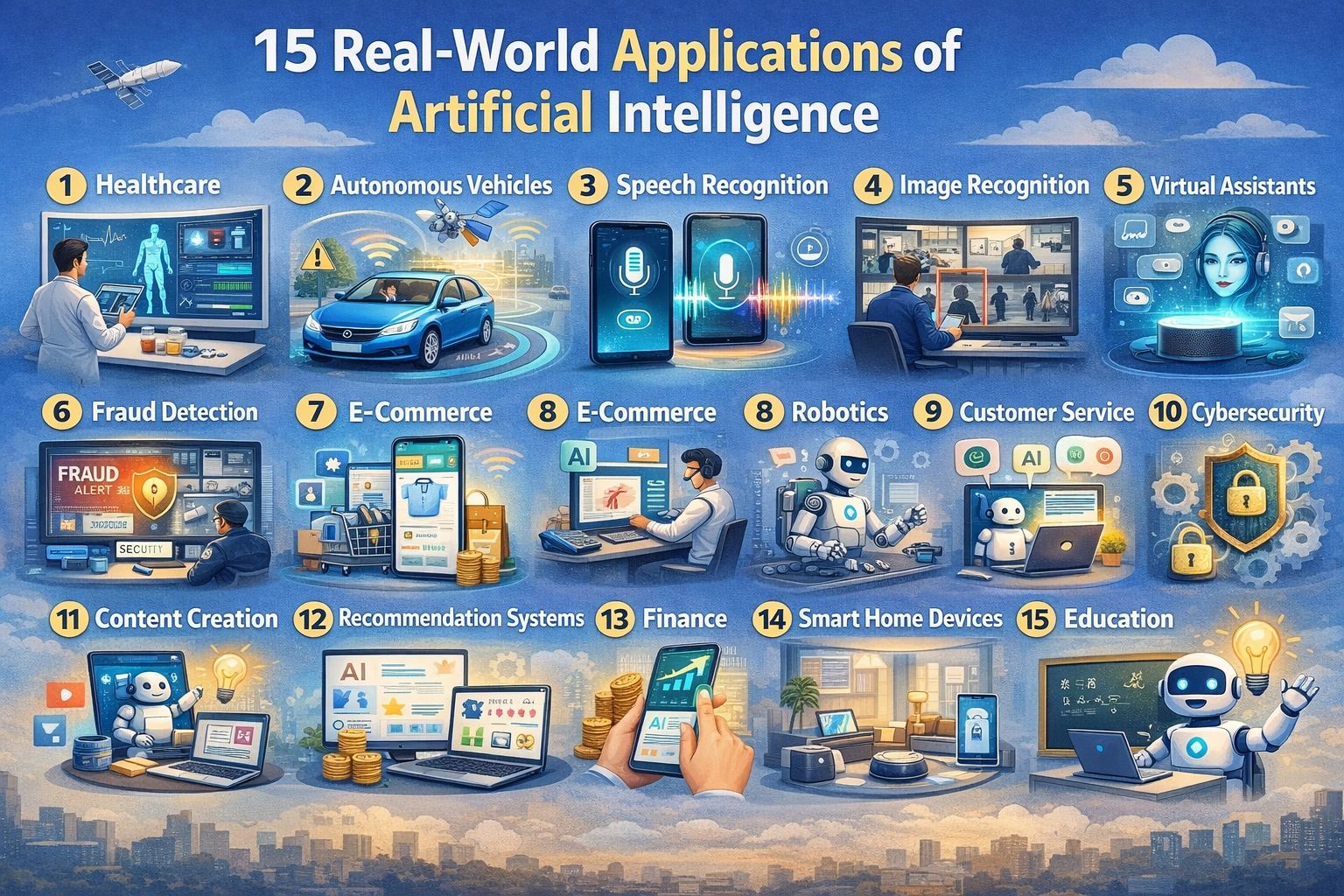
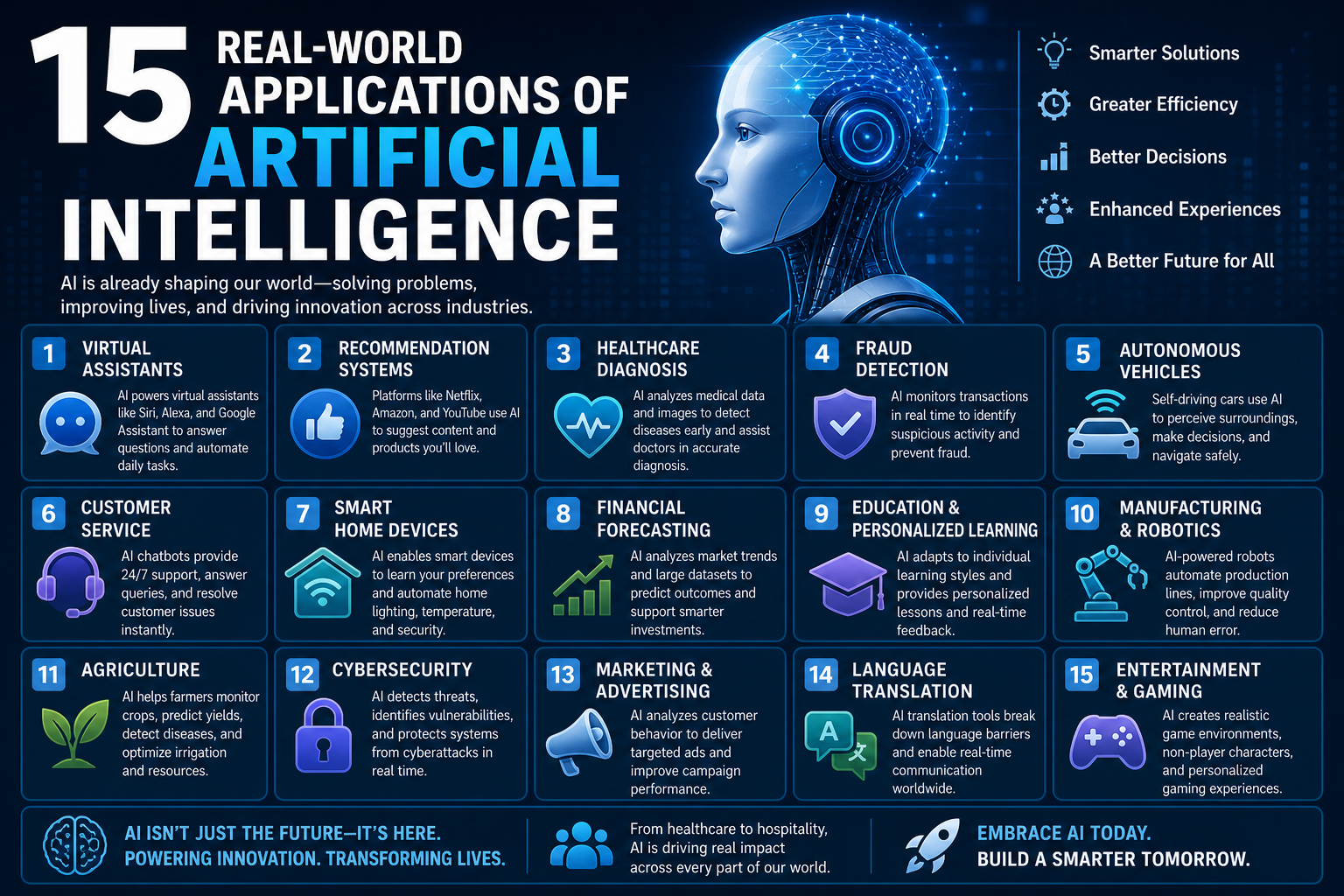
This guide explores fifteen real-world applications of artificial intelligence that are actively changing how we live and work. Some are obvious—the virtual assistants we talk to daily. Others operate behind the scenes, quietly optimizing systems we rarely think about. All of them demonstrate that AI isn’t a future technology. It’s here, it’s now, and it’s only going to become more woven into our lives through these real-world AI applications.
Let’s dive into these practical AI examples and see how artificial intelligence is transforming our world.
Application 1: Healthcare
AI in healthcare might be the most impactful of all real-world applications of artificial intelligence. It’s saving lives, improving diagnoses, and making medicine more personal. This practical use of AI demonstrates how technology can directly improve human well-being.
Medical Imaging and Diagnosis
The numbers are striking: the FDA has already approved more than 250 AI applications for medical scanning . In head-to-head comparisons, AI achieves about 50% diagnostic accuracy in some domains, compared to 40% for human doctors. Together, humans and AI achieve 60%—better than either alone . This real-world AI application is literally saving lives.
This matters because medical errors are deadly. An estimated 200,000 North Americans die annually from misdiagnosis . Even modest improvements in accuracy translate to lives saved. The practical applications of artificial intelligence in radiology are particularly promising.
AI is also seeing what humans miss. Machine learning models can detect patterns in retinal scans that predict cardiovascular risk—information doctors couldn’t extract without algorithmic help . In radiology, AI flags suspicious nodules that human eyes might overlook after a long shift. This is one of the most powerful AI use cases in healthcare.
Drug Discovery
DeepMind’s AlphaFold, which predicts protein structures, was awarded the Nobel Prize in Chemistry . Dozens of AI-designed drugs are now in development pipelines . Traditional drug development takes decades and billions of dollars. AI can simulate molecular interactions, predict side effects, and identify promising candidates in months. This real-world application of AI is accelerating medical breakthroughs.
Personalized Treatment
AI analyzes patient data—genetics, lifestyle, medical history—to recommend treatments tailored to individuals. Instead of one-size-fits-all protocols, medicine is becoming personalized through AI applications in healthcare.
Example: IBM Watson Oncology analyzes medical literature and patient records to suggest treatment options, helping oncologists consider possibilities they might have missed. This practical AI example shows how machines augment human expertise.
Application 2: Autonomous Vehicles
Self-driving cars have moved from sci-fi to our streets. Autonomous vehicles represent one of the most complex real-world applications of artificial intelligence, combining computer vision, sensor fusion, real-time decision-making, and predictive modeling.
How They Work
Autonomous vehicles use a combination of technologies:
| Component | Function |
|---|---|
| Cameras | Visual recognition of lanes, signs, obstacles |
| Lidar | Laser-based distance measurement |
| Radar | Detection in poor weather |
| GPS | Positioning and navigation |
| AI algorithms | Processing all inputs and making driving decisions |
This real-world AI application requires processing massive amounts of data in milliseconds—a task only machine learning can handle.
Current State
Companies like Waymo, Tesla, Cruise, and others have logged millions of autonomous miles. Waymo operates fully driverless ride-hailing services in Phoenix and San Francisco. Tesla’s “Full Self-Driving” system, while requiring supervision, handles highway driving, lane changes, and traffic lights. These practical AI examples are on roads today.
Benefits and Challenges
| Benefit | Challenge |
|---|---|
| Reduced accidents (human error causes 94% of crashes) | Technical edge cases (unpredictable situations) |
| Mobility for elderly and disabled | Regulatory frameworks |
| Less traffic congestion | Public trust |
| Lower emissions | High development costs |
The future: Fully autonomous vehicles are coming gradually through these real-world AI applications. Expect widespread adoption in controlled environments (highways, fleets) before personal vehicles are truly hands-off.
Application 3: Speech Recognition
Speech recognition has become so accurate that we barely think about it. It’s the technology behind dictation, voice commands, and transcription services—one of the most widely used AI applications in the real world.
How It Works
Modern speech recognition uses deep learning models trained on thousands of hours of spoken language. These models account for accents, background noise, and speaking styles, continuously improving through use. This practical use of artificial intelligence improves every time someone uses it.
Everyday Applications
| Application | Examples |
|---|---|
| Virtual assistants | Siri, Google Assistant, Alexa |
| Dictation software | Dragon NaturallySpeaking, built-in phone dictation |
| Transcription services | Otter.ai, Rev, Zoom transcripts |
| Accessibility tools | Speech-to-text for hearing impaired |
| Customer service | Automated phone systems that understand natural language |
These real-world AI examples demonstrate how speech recognition has become part of daily routines.
Real-World Impact
For people with disabilities, speech recognition is transformative. Those with mobility impairments can control devices hands-free. People with hearing loss can read real-time transcriptions of conversations. This AI application creates accessibility that didn’t exist before.
Example: A journalist interviews a source while Otter.ai transcribes everything, allowing focus on the conversation rather than frantic note-taking. This practical AI use case saves hours of work.
Application 4: Image Recognition
Image recognition lets computers “see” and understand visual content. It’s one of the most mature real-world applications of artificial intelligence, with uses from social media to security.
How It Works
Deep learning models are trained on millions of labeled images. They learn to identify patterns—edges, shapes, textures, objects—and classify what they see. These AI applications in the real world improve as more data becomes available.
Applications Across Industries
| Industry | Use Case |
|---|---|
| Social media | Auto-tagging friends in photos |
| Security | Facial recognition for access control |
| Retail | Visual search (“find products like this”) |
| Healthcare | Analyzing X-rays and MRIs |
| Manufacturing | Quality control (defect detection) |
| Agriculture | Crop monitoring and disease identification |
These real-world AI examples show how image recognition creates efficiency across sectors.
Controversies
Facial recognition raises privacy concerns. Some cities have banned government use. The technology is improving, but bias issues remain—systems trained primarily on certain demographics perform worse on others. This highlights the importance of responsible AI applications.
Example: Google Photos lets you search your library for “dog,” “beach,” or “birthday cake” without anyone manually tagging images. This practical AI use organizes memories automatically.
Application 5: Virtual Assistants
Siri, Alexa, Google Assistant, and others have become household names. Virtual assistants combine speech recognition, natural language processing, and task execution—making them among the most visible real-world applications of artificial intelligence.
What They Do
| Function | Examples |
|---|---|
| Answer questions | “What’s the weather today?” |
| Set reminders | “Remind me to call Mom at 3 PM” |
| Control smart devices | “Turn off the living room lights” |
| Play media | “Play jazz music” |
| Shopping | “Order more paper towels” |
| Communication | “Text Sarah I’m running late” |
These AI use cases demonstrate how natural language interaction has become mainstream.
Behind the Scenes
When you speak to a virtual assistant:
- Speech recognition converts audio to text
- Natural language processing interprets intent
- Task execution performs the action or retrieves information
- Speech synthesis responds verbally
This sequence represents multiple real-world AI applications working together seamlessly.
The Future
Assistants are becoming more conversational and proactive through advanced AI applications. Instead of waiting for commands, they might suggest actions based on context: “You usually leave for work now; traffic is heavy today, so you should leave early.”
Example: A Google Assistant user says, “Hey Google, what’s my day like?” The assistant reads calendar events, checks commute time, and reminds of upcoming tasks—all in seconds. This practical AI example saves time daily.
Application 6: Fraud Detection
Every time your bank alerts you to suspicious activity, AI is working. Fraud detection is one of the most valuable real-world applications of artificial intelligence in finance.
How It Works
AI models analyze transaction patterns in real time. They learn what “normal” looks like for each customer—typical locations, purchase amounts, merchant types—and flag deviations. This AI application protects billions of dollars annually.
| Factor Analyzed | What It Detects |
|---|---|
| Location | Transaction in another country minutes after local use |
| Amount | Unusually large purchase |
| Merchant category | First-time purchase at unusual merchant |
| Time | 3 AM transaction when you’re usually asleep |
| Frequency | Multiple rapid transactions |
Benefits
| Stakeholder | Benefit |
|---|---|
| Consumers | Reduced financial loss, peace of mind |
| Banks | Lower fraud-related costs, regulatory compliance |
| Merchants | Fewer chargebacks |
These benefits make fraud detection one of the most economically valuable real-world AI applications.
Real-World Impact
Mastercard’s AI systems analyze each transaction in milliseconds, reducing false declines while catching more fraud. The result: better security with less friction through this practical use of artificial intelligence.
Example: You’re on vacation in Paris. Your bank’s AI notices this is unusual for you but also sees you’ve used the same card at your hotel and a local café. It approves transactions but flags them for review—learning that you’re actually traveling. This AI use case balances security and convenience.
Application 7: E-Commerce
AI in e-commerce powers everything from product recommendations to inventory management. It’s why Amazon seems to know what you want before you do—a classic real-world application of artificial intelligence.
Personalization
When you visit an e-commerce site, AI analyzes:
- Your browsing history
- Past purchases
- Items in your cart
- Time spent on products
- What similar customers bought
It then recommends products you’re likely to purchase. These recommendations drive significant revenue—up to 35% of Amazon’s sales come from recommendations . This AI application is worth billions.
Inventory and Pricing
| Application | How AI Helps |
|---|---|
| Demand forecasting | Predicts what products will sell when |
| Dynamic pricing | Adjusts prices based on demand, competition, inventory |
| Supply chain optimization | Routes inventory efficiently |
| Fraud prevention | Flags suspicious transactions |
These practical AI examples keep e-commerce running efficiently.
Customer Experience
Chatbots handle customer inquiries 24/7. Visual search lets users upload photos to find matching products. Virtual try-on shows how clothes might look. These real-world AI applications create seamless shopping experiences.
Example: You search for “running shoes” on Amazon. The site shows you options, but also recommends socks, hydration packs, and fitness trackers—items frequently bought together. This AI use case increases convenience and sales simultaneously.
Application 8: Robotics
Robotics combined with AI creates machines that can perceive, reason, and act in the physical world. This goes far beyond factory automation into sophisticated real-world applications of artificial intelligence.
Types of AI-Powered Robots
| Type | Applications |
|---|---|
| Industrial robots | Manufacturing, assembly, packaging |
| Service robots | Cleaning, delivery, hospitality |
| Medical robots | Surgery assistance, rehabilitation |
| Agricultural robots | Harvesting, weeding, monitoring |
| Consumer robots | Vacuum cleaners, lawn mowers |
How AI Enhances Robotics
Traditional robots follow pre-programmed instructions. AI-enabled robots can:
- Perceive their environment through sensors
- Learn from experience
- Adapt to changing conditions
- Collaborate with humans safely
These capabilities make robotics one of the most dynamic AI applications in the real world.
Real-World Examples
| Robot | Function |
|---|---|
| Roomba | Learns home layout, optimizes cleaning paths |
| Boston Dynamics’ Spot | Inspects industrial sites, navigates rough terrain |
| Da Vinci surgical system | Assists surgeons with precise movements |
| Amazon warehouse robots | Move shelves to workers, optimizing logistics |
Example: A warehouse robot doesn’t just follow a fixed path. It detects obstacles, recalculates routes, and prioritizes tasks based on order deadlines—all autonomously through real-world AI applications.
Application 9: Customer Service
Remember waiting on hold for hours? Those days are ending. AI in customer service handles routine inquiries instantly, 24/7, making it one of the most visible real-world applications of artificial intelligence for consumers.
Chatbots and Virtual Agents
Modern chatbots are far beyond the frustrating “press 1 for…” systems. They understand natural language, maintain context, and can resolve many issues without human intervention. This AI application is transforming customer experience.
| Capability | Example |
|---|---|
| Answer FAQs | “What’s your return policy?” |
| Track orders | “Where’s my package?” |
| Troubleshoot | “My internet isn’t working” |
| Process returns | “I need to return this item” |
| Schedule appointments | “Book a service call” |
Human + AI Collaboration
The best customer service combines AI efficiency with human empathy through thoughtful AI applications:
- AI handles routine inquiries instantly
- Complex issues escalate to humans with full context
- Humans focus on problems requiring judgment, emotion, or creativity
Benefits
| Benefit | Explanation |
|---|---|
| 24/7 availability | Never closed |
| Instant responses | No waiting |
| Consistency | Same answer every time |
| Scalability | Handle thousands simultaneously |
| Cost reduction | Fewer support staff needed |
Example: A telecom company’s AI assistant handles password resets, bill inquiries, and outage checks. When a customer’s issue is complex, it transfers to a human—along with the conversation history and suggested solutions. This practical AI example creates efficiency without sacrificing quality.
Application 10: Cybersecurity
As cyber threats evolve, so must defenses. AI in cybersecurity detects and responds to attacks faster than humans ever could. This is one of the most critical real-world applications of artificial intelligence.
How AI Protects
| Function | Description |
|---|---|
| Threat detection | Identifies unusual patterns indicating attacks |
| Malware analysis | Recognizes new malware variants |
| Network monitoring | Watches for suspicious traffic |
| User behavior analytics | Flags compromised accounts |
| Automated response | Blocks threats instantly |
These AI use cases operate at machine speed, stopping attacks before they spread.
Why AI Is Essential
| Challenge | AI Solution |
|---|---|
| Volume of threats | Millions daily—humans can’t keep up |
| Speed of attacks | Some attacks spread in seconds |
| New variants | AI detects novel threats by behavior, not just signatures |
| Sophistication | AI identifies subtle patterns humans miss |
Real-World Example
Darktrace’s Enterprise Immune System learns what “normal” looks like in an organization’s network through AI applications. When it detects something anomalous—a server communicating with an unknown external IP—it can automatically contain the threat while alerting security teams.
Example: A hospital’s system detects ransomware attempting to encrypt files. AI instantly isolates affected devices, stopping the spread before critical patient data is compromised. This real-world AI application literally saves lives.
Application 11: Content Creation
Generative AI has exploded into public consciousness. AI content creation now produces text, images, video, and music that rivals human output—one of the most talked-about real-world applications of artificial intelligence.
Types of Content AI Creates
| Medium | Tools | Applications |
|---|---|---|
| Text | ChatGPT, Claude, Jasper | Articles, emails, social media, reports |
| Images | Midjourney, DALL-E, Stable Diffusion | Marketing, design, art |
| Video | Runway, Synthesia | Short-form content, avatars |
| Audio | ElevenLabs, Descript | Voiceovers, music, podcasts |
| Code | GitHub Copilot, Cursor | Software development |
These practical AI examples are transforming creative industries.
How It’s Used
| Use Case | Benefit |
|---|---|
| Marketing copy | Generate variations, test quickly |
| First drafts | Overcome writer’s block |
| Personalization | Tailor content to individuals |
| Accessibility | Describe images for visually impaired |
| Rapid prototyping | Visualize concepts instantly |
The Human Role
AI doesn’t replace creativity—it amplifies it. Humans provide direction, taste, and final polish. The best results come from collaboration with these AI applications.
Example: A marketer needs ten social media posts. They give ChatGPT brand guidelines and topics, get ten drafts in seconds, then edit for voice and accuracy—turning an hour’s work into ten minutes. This real-world AI use case boosts productivity dramatically.
Application 12: Recommendation Systems
Every time Netflix suggests a show or Spotify creates a playlist, recommendation systems are at work. They’re among the most profitable real-world applications of artificial intelligence in existence.
How They Work
Recommendation systems use two main approaches:
| Approach | How It Works | Example |
|---|---|---|
| Collaborative filtering | “People like you liked this” | Amazon’s “Customers who bought…” |
| Content-based filtering | “This item is similar to ones you liked” | Spotify’s “Recommended for you” |
| Hybrid | Combines both | Most modern systems |
These AI applications keep users engaged and spending.
Data Sources
Recommendation engines analyze:
- Past purchases or views
- Ratings and reviews
- Search history
- Demographics
- Time of day
- Device type
- What similar users did
Business Impact
| Platform | Impact |
|---|---|
| Netflix | 80% of watched content comes from recommendations |
| Amazon | 35% of sales from recommendations |
| Spotify | Discover Weekly drives engagement |
| YouTube | Recommendations determine watch time |
Example: You finish a true crime podcast. Spotify immediately suggests similar podcasts, plus a playlist of atmospheric music for focus—keeping you in the app longer through AI applications.
Application 13: Finance
AI in finance touches everything from trading to lending to personal budgeting. It’s making markets more efficient and financial services more accessible through real-world applications of artificial intelligence.
Applications Across Finance
| Area | AI Application |
|---|---|
| Trading | Algorithmic trading executes millions of orders |
| Risk assessment | Evaluates loan applications |
| Fraud detection | Flags suspicious transactions |
| Personal finance | Apps like Mint categorize spending |
| Customer service | Chatbots answer banking questions |
| Regulatory compliance | Monitors for suspicious activity |
Algorithmic Trading
High-frequency trading firms use AI to execute trades in milliseconds, exploiting tiny price differences. These algorithms analyze market data, news, and social media to predict movements—a sophisticated AI use case.
Credit Scoring
Traditional credit scores exclude many people. AI analyzes alternative data—rent payments, utility bills, education—to assess creditworthiness for those without traditional history. This practical AI example expands financial inclusion.
Personal Finance Apps
| App | AI Feature |
|---|---|
| Mint | Automatically categorizes transactions |
| You Need A Budget | Predicts cash flow |
| Cleo | Chatbot provides spending insights |
| Personal Capital | Portfolio analysis and recommendations |
Example: A freelancer with irregular income uses an AI-powered budgeting app. It analyzes spending patterns, predicts slow months, and suggests setting aside extra during good months. This real-world AI application provides financial guidance previously available only from human advisors.
Application 14: Smart Home Devices
Your home is getting smarter. Smart home devices use AI to learn your preferences, automate routines, and save energy—making them among the most personal real-world applications of artificial intelligence.
Common Devices
| Device | AI Capabilities |
|---|---|
| Smart thermostats | Learn temperature preferences, optimize energy |
| Smart lights | Adjust based on time, occupancy |
| Smart speakers | Voice control, music, information |
| Smart locks | Recognize residents, grant access |
| Security cameras | Distinguish people from animals, alert to activity |
| Appliances | Refrigerators that track groceries, ovens that suggest recipes |
How They Learn
Smart devices build profiles over time through AI applications:
- Nest thermostat learns when you’re home, when you sleep, what temperature you prefer
- Philips Hue lights learn your routines and suggest automation
- Ring cameras learn what’s normal in your neighborhood
Benefits
| Benefit | Example |
|---|---|
| Convenience | Lights turn on when you enter a room |
| Energy savings | Thermostat adjusts when you’re away |
| Security | Cameras alert to unusual activity |
| Peace of mind | Check door locks from anywhere |
Example: You arrive home at 6 PM. Your smart home knows your schedule: lights turn on, thermostat adjusts to your preferred evening temperature, and your favorite playlist starts playing. This real-world AI example creates comfort automatically.
Application 15: Education
AI in education is personalizing learning and supporting teachers. It’s one of the most promising real-world applications of artificial intelligence for social impact.
Personalized Learning
Every student learns differently. AI tutors adapt to individual pace, style, and needs through sophisticated AI applications:
| Capability | Example |
|---|---|
| Pacing | Moves faster when student excels, reviews when struggling |
| Content adaptation | Presents material in preferred format (video, text, interactive) |
| Immediate feedback | Corrects mistakes instantly |
| Practice generation | Creates unlimited practice problems |
| Engagement tracking | Notices when student loses focus |
Teacher Support
AI isn’t replacing teachers—it’s giving them superpowers through practical AI examples:
| Task | AI Assistance |
|---|---|
| Grading | Automated initial assessment |
| Lesson planning | Generate ideas, materials |
| Identifying struggling students | Early warning systems |
| Administrative work | Emails, scheduling, reports |
| Parent communication | Draft updates, translate languages |
Real-World Examples
| Tool | Function |
|---|---|
| Khan Academy’s Khanmigo | AI tutor for students |
| Carnegie Learning | Math curriculum with AI |
| Duolingo | Language learning with AI adaptation |
| Century Tech | Personalized learning paths |
Example: A high school student struggles with algebra. An AI tutor identifies exactly which concepts are confusing, presents them in a new way, and generates practice problems until mastery—all while the teacher works with other students. This real-world AI application provides personalized attention at scale.
Putting It All Together
These fifteen applications show how deeply AI is woven into modern life. From healthcare to education, from finance to entertainment, real-world applications of artificial intelligence are quietly making things better, faster, and more personalized.
What’s striking is how many of these AI applications in the real world work together. Speech recognition enables virtual assistants. Recommendation systems drive e-commerce. Fraud detection protects finance. Image recognition powers autonomous vehicles. AI isn’t a single technology—it’s a constellation of capabilities that amplify each other through these practical AI examples.
The Future
What comes next? Several trends are accelerating in real-world applications of artificial intelligence:
| Trend | Implication |
|---|---|
| Multimodal AI | Systems that understand text, images, speech together |
| AI agents | Systems that take action, not just give answers |
| Edge AI | AI running on devices, not just in the cloud |
| Regulation | Governments creating frameworks for safe AI |
| Democratization | AI tools accessible to everyone |
The AI applications we’ve covered will only become more sophisticated, more integrated, and more invisible. The best AI is the kind you don’t notice—it just makes things work through these real-world AI use cases.
Conclusion
Let’s recap the fifteen real-world applications of artificial intelligence we’ve explored:
- Healthcare – Diagnosing disease, discovering drugs, personalizing treatment
- Autonomous Vehicles – Self-driving cars and trucks
- Speech Recognition – Converting spoken words to text
- Image Recognition – Identifying objects, faces, scenes
- Virtual Assistants – Siri, Alexa, Google Assistant
- Fraud Detection – Protecting financial transactions
- E-Commerce – Recommendations, inventory, pricing
- Robotics – Intelligent machines in factories, homes, hospitals
- Customer Service – Chatbots and automated support
- Cybersecurity – Detecting and stopping threats
- Content Creation – Generating text, images, video, music
- Recommendation Systems – Netflix, Spotify, Amazon suggestions
- Finance – Trading, lending, personal finance
- Smart Home Devices – Thermostats, lights, security
- Education – Personalized learning, teacher support
What ties all these real-world applications of artificial intelligence together is a common thread: AI excels at tasks involving pattern recognition at scale. It can process more data, faster, and find patterns humans would miss. That capability, applied across domains, is transforming how we live through these AI applications.
But notice what’s missing from this list of real-world AI examples. AI doesn’t replace human judgment, creativity, or connection. In healthcare, it assists doctors—it doesn’t replace them. In education, it supports teachers. In customer service, it handles routine inquiries so humans can focus on complex ones. The best outcomes from AI applications in the real world come from human-AI collaboration, not replacement.
The question isn’t whether AI will affect your life—it already has through these real-world applications of artificial intelligence. The question is whether you’ll understand it enough to use it intentionally rather than being used by it. The more you know about these practical AI examples, the better equipped you are to navigate a world where AI is everywhere.
The future isn’t AI versus humans. It’s AI with humans. And that future is already here, powered by these remarkable real-world applications of artificial intelligence.



Leave a Reply