

I remember walking into a warehouse last year that looked nothing like the warehouses I remembered from a decade ago. No clipboard-wielding supervisors. No frantic searching for misplaced inventory. No stacks of paper forms. Instead, a fleet of small autonomous robots glided silently through aisles, scanning barcodes and updating inventory in real time. A manager sat at a desk with a tablet, watching a dashboard that predicted—before the end of the day—which products would need reordering by week’s end.
When I asked how long it took to implement this system, the manager shrugged. “Six months. And it paid for itself in the first year.”
That’s the reality of how AI is transforming businesses globally in 2026. It’s not the flashy AI of science fiction movies. It’s the invisible AI that optimizes supply chains, automates customer service, predicts equipment failures, and surfaces insights from oceans of data. It’s AI that doesn’t replace jobs but transforms them—freeing people to do work that actually requires human judgment.
The numbers tell the story. According to recent data, companies that fully integrate AI into their operations see profit margins increase by 5-15% within three years. Gartner predicts that by 2026, 75% of enterprises will have operationalized AI in their core business processes. And Deloitte found that organizations using AI in operations report 50% faster decision-making.
In this guide, we’ll explore how AI is transforming businesses globally across every function—from customer service and marketing to supply chain and finance. We’ll look at real-world examples, practical implementation strategies, and what’s coming next.
Let’s dive into the intelligent future of business.
Part 1: The AI Revolution in Business
How AI is transforming businesses globally isn’t a future prediction—it’s happening right now.
The Three Waves of AI Adoption
| Wave | Phase | Characteristics |
|---|---|---|
| Wave 1 | Experimentation (2015-2020) | Pilot projects, isolated use cases |
| Wave 2 | Integration (2020-2025) | AI embedded into core processes |
| Wave 3 | Transformation (2025+) | AI-driven business models, autonomous operations |
We’re currently in Wave 3. The question is no longer “Should we use AI?” but “How do we use AI better than our competitors?”
Key Drivers of AI Transformation
| Driver | Impact |
|---|---|
| Data abundance | More data than ever to train models |
| Computing power | Cloud AI accessible to any business |
| AI maturity | From experimental to production-ready |
| Workforce pressures | Automation fills labor gaps |
| Competitive pressure | Early adopters gaining advantages |
Part 2: Improved Productivity
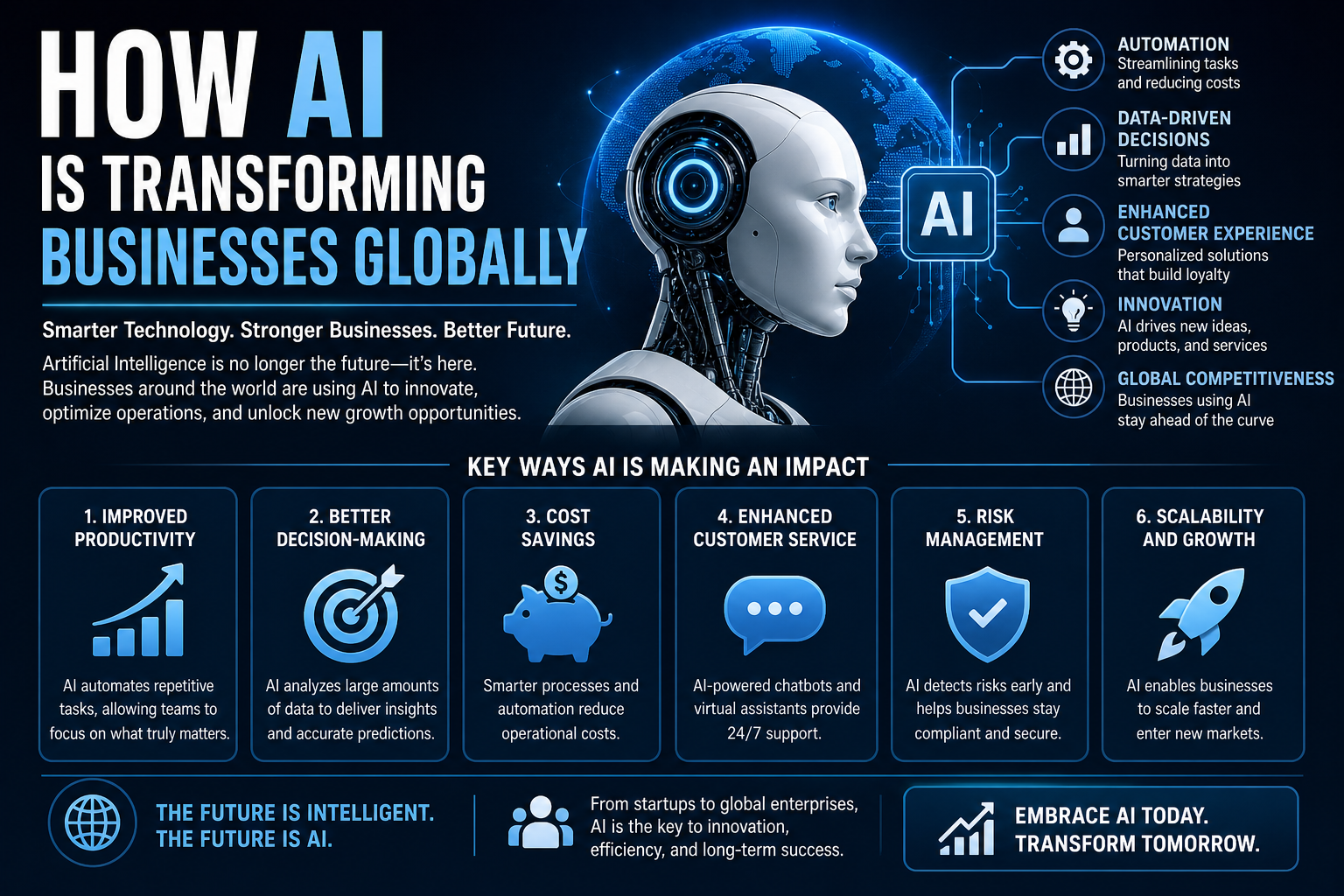
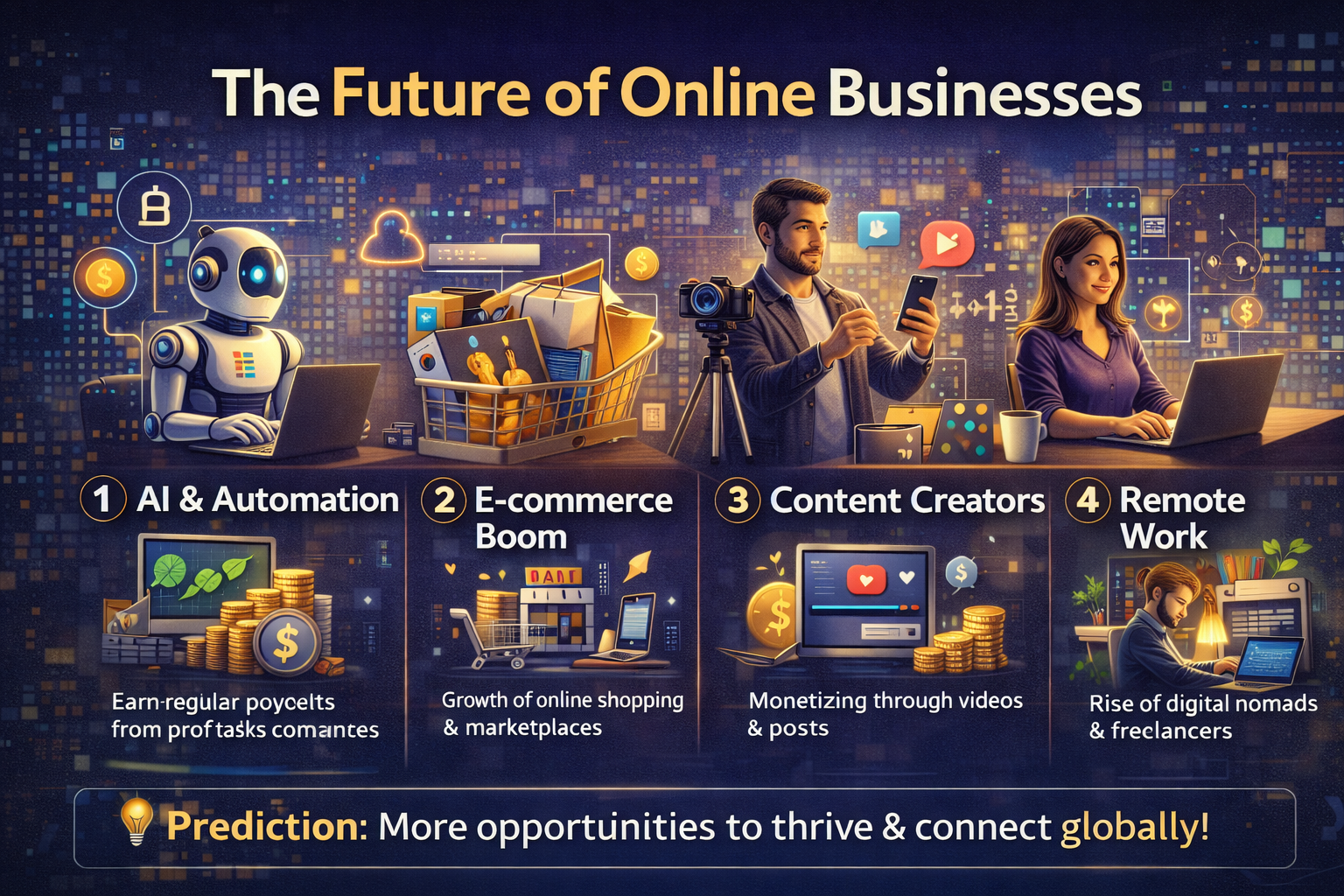
Based on the image you shared, this is the first way how AI is transforming businesses globally—improved productivity.
What AI Automation Looks Like
| Task | Before AI | After AI | Time Saved |
|---|---|---|---|
| Data entry | Hours manually | Minutes (automated) | 80-90% |
| Report generation | Days compiling | Seconds generating | 95% |
| Email triage | 2 hours daily | 15 minutes | 75% |
| Meeting notes | Manual transcription | AI-generated instantly | 100% |
| Code writing | Hours coding | Minutes with Copilot | 70% |
Real-World Example
A mid-sized marketing agency used AI to automate their social media posting, email newsletters, and client reporting. Three employees who spent 20 hours weekly on these tasks now spend 5 hours. The agency took on 40% more clients without hiring.
How to Apply
| Action | Benefit |
|---|---|
| Identify repetitive tasks | What do you do weekly that follows a pattern? |
| Test AI tools | Start with one tool for one task |
| Measure time saved | Quantify the impact |
| Scale to other areas | Apply learnings across the business |
Pro tip: The biggest productivity gains come from automating tasks, not entire jobs. Focus on the 20% of tasks that take 80% of your time.
Part 3: Better Decision-Making
Second on the list of how AI is transforming businesses globally is better decision-making.
How AI Improves Decisions
| Traditional Decision-Making | AI-Enhanced Decision-Making |
|---|---|
| Based on gut feeling | Based on data |
| Limited to historical data | Incorporates real-time data |
| Human biases affect outcomes | Algorithms identify patterns |
| Slow, manual analysis | Instant, automated insights |
Real-World Example
A retail chain used AI to optimize inventory. The system analyzed weather patterns, local events, and historical sales to predict demand. Result: 15% reduction in out-of-stocks and 10% reduction in excess inventory.
Types of AI-Powered Decisions
| Type | Example |
|---|---|
| Predictive | “Which customers are likely to churn?” |
| Prescriptive | “What discount should we offer to retain them?” |
| Real-time | “Should we approve this transaction?” |
| Strategic | “Which markets should we enter next?” |
Pro tip: Start with a single decision you make frequently. Train AI on historical outcomes. Compare AI recommendations to your decisions.
Part 4: Cost Savings
The third way how AI is transforming businesses globally is through significant cost savings.
Where Companies Save
| Area | Cost Reduction | How AI Helps |
|---|---|---|
| Customer service | 30-50% | Chatbots handle routine inquiries |
| Supply chain | 10-20% | Optimized inventory, routing |
| Marketing | 20-30% | Targeted ads, reduced waste |
| IT operations | 15-25% | Predictive maintenance |
| HR | 20-40% | Automated screening, onboarding |
Real-World Example
A logistics company used AI to optimize delivery routes. The system considered traffic, weather, package volume, and delivery windows in real time. Result: 15% reduction in fuel costs and 20% increase in deliveries per driver.
The ROI of AI
| Investment | Typical ROI Timeline | Long-Term Impact |
|---|---|---|
| Chatbot for customer service | 6-12 months | 50% lower support costs |
| AI inventory optimization | 9-12 months | 20% lower inventory costs |
| Predictive maintenance | 12-18 months | 30% less downtime |
| AI marketing personalization | 6-9 months | 30% higher conversion |
Pro tip: Start with high-volume, repetitive processes. They deliver the fastest ROI.
Part 5: Enhanced Customer Service
Fourth on the list of how AI is transforming businesses globally is enhanced customer service.
The AI Customer Service Revolution
| Capability | Before AI | After AI |
|---|---|---|
| Response time | Hours to days | Seconds |
| Availability | Business hours | 24/7 |
| Consistency | Varies by agent | Consistent across all interactions |
| Personalization | Generic responses | Tailored to customer history |
Real-World Example
Bank of America’s virtual assistant, Erica, has handled over 1.5 billion client interactions. It handles everything from balance inquiries to fraud detection. Customers get instant answers. Human agents focus on complex issues.
How to Implement AI Customer Service
| Step | Action |
|---|---|
| 1 | Identify common customer questions (top 20-30) |
| 2 | Build a knowledge base of answers |
| 3 | Implement chatbot for these common questions |
| 4 | Train agents to handle escalations |
| 5 | Continuously improve based on customer feedback |
Pro tip: AI handles 80% of routine questions. Humans handle 20% that require empathy, judgment, or complexity.
Part 6: Risk Management
The fifth way how AI is transforming businesses globally is through better risk management.
What AI Can Detect
| Risk Type | What AI Monitors |
|---|---|
| Fraud | Unusual transaction patterns |
| Cybersecurity | Anomalous network activity |
| Compliance | Policy violations |
| Operational | Equipment failure prediction |
| Financial | Market anomalies, credit risk |
Real-World Example
A financial institution used AI for fraud detection. The system analyzed millions of transactions in real time, flagging suspicious activity instantly. Result: 50% reduction in fraud losses and 80% fewer false positives.
The Numbers
| Metric | Without AI | With AI |
|---|---|---|
| Fraud detection rate | 50-70% | 90-99% |
| False positive rate | 10-20% | 1-2% |
| Response time | Hours to days | Milliseconds |
Pro tip: AI doesn’t replace human judgment—it augments it. Use AI to flag potential issues. Let humans investigate and decide.
Part 7: Scalability and Growth
The sixth way how AI is transforming businesses globally is enabling scalability and growth.
How AI Enables Scale
| Traditional Scaling | AI-Powered Scaling |
|---|---|
| Hire more people | Automate processes |
| Open more locations | Serve globally from anywhere |
| Limited by human capacity | Limited only by compute |
| Linear growth | Exponential potential |
Real-World Example
A small e-commerce business used AI to personalize product recommendations. Without hiring additional staff, they increased average order value by 25% and conversion rate by 15%. They scaled from 1Mto5M in revenue with the same team.
The Growth Flywheel
| Stage | Action | Result |
|---|---|---|
| 1 | AI automates operations | Lower costs |
| 2 | Lower costs enable lower prices | More customers |
| 3 | More customers generate more data | Better AI |
| 4 | Better AI improves operations | Lower costs (repeat) |
Pro tip: Use AI to remove bottlenecks in your growth. Identify what’s currently limiting your ability to scale.
Part 8: How to Start Your AI Transformation
Knowing how AI is transforming businesses globally is one thing. Implementing it is another.
The 5-Step AI Adoption Framework
| Step | Action | Timeline |
|---|---|---|
| 1 | Audit your processes – Where are bottlenecks? What’s repetitive? | 1-2 weeks |
| 2 | Identify quick wins – Choose 1-2 processes for pilot | 1 week |
| 3 | Select AI tools – Research options for your use case | 2 weeks |
| 4 | Run pilot – Test on small scale, measure results | 4-8 weeks |
| 5 | Scale and iterate – Expand to other areas, continuously improve | Ongoing |
Common Starting Points
| Business Function | Easy AI Win |
|---|---|
| Customer service | Chatbot for FAQs |
| Marketing | AI-generated social content |
| Sales | Lead scoring and prioritization |
| Operations | Email automation |
| Finance | Invoice processing |
The AI Readiness Checklist
| Question | If No, Do This |
|---|---|
| Do you have clean, organized data? | Invest in data cleaning |
| Does your team understand AI basics? | Provide training |
| Do you have leadership buy-in? | Build business case |
| Do you have a clear problem to solve? | Start with outcomes, not technology |
Pro tip: Start with a pilot that can show results in 30-60 days. Early wins build momentum.
Part 9: Challenges and How to Overcome Them
Even with all the benefits of how AI is transforming businesses globally, challenges exist.
Common AI Implementation Challenges
| Challenge | Solution |
|---|---|
| Data quality | Invest in data governance and cleaning |
| Skills gap | Partner with AI vendors, hire AI talent, train existing staff |
| Integration complexity | Start with standalone tools, build toward integration |
| Cost | Start small, focus on high-ROI use cases |
| Employee resistance | Communicate benefits, involve staff in implementation |
| Security and privacy | Work with reputable vendors, audit regularly |
Real-World Failure and Recovery
A manufacturing company tried to implement AI for predictive maintenance but failed because their sensor data was inconsistent. They paused, spent three months standardizing data collection, and relaunched. The second attempt succeeded, saving $2M annually in prevented downtime.
Lesson: Data quality is not optional. Fix your data before building AI.
Part 10: The Future of AI in Business
Where is how AI is transforming businesses globally headed next?
Near-Term Trends (1-3 Years)
| Trend | Impact |
|---|---|
| AI agents | Autonomous task completion |
| Generative AI integration | AI creating content, code, designs |
| Industry-specific AI | AI trained on your industry data |
| AI-powered decision intelligence | Prescriptive, not just predictive |
Long-Term Possibilities (3-10 Years)
| Possibility | Implication |
|---|---|
| Autonomous operations | AI-run businesses |
| AI-human collaboration | Redesigned roles |
| Democratized AI | Anyone can build AI tools |
| AI governance | Regulation and standards |
What Leaders Should Do Now
| Action | Why |
|---|---|
| Build data infrastructure | AI runs on data |
| Develop AI literacy | Leaders must understand AI |
| Experiment continuously | What works today may not work tomorrow |
| Focus on ethics | Trust is competitive advantage |
Conclusion
Let’s bring this together.
How AI is transforming businesses globally isn’t a future prediction—it’s happening now. From improved productivity and better decision-making to cost savings, enhanced customer service, risk management, and scalability, AI is reshaping every function of business.
The key takeaways:
| Area | Impact |
|---|---|
| Productivity | Automate repetitive tasks, free human creativity |
| Decision-making | Data-driven insights, real-time analysis |
| Cost savings | 10-50% reduction in operational costs |
| Customer service | 24/7 support, instant responses |
| Risk management | Early detection, reduced losses |
| Scalability | Grow without linear headcount increases |
The question isn’t whether AI will transform your business. It already is. The question is whether you’ll lead that transformation or be disrupted by it.
Start small. Identify one process. Pilot one tool. Measure results. Scale what works. Build AI literacy across your team. And never lose sight of the human element—AI is a tool to augment people, not replace them.
The future is intelligent. The future is AI. Embrace it today.






Leave a Reply