

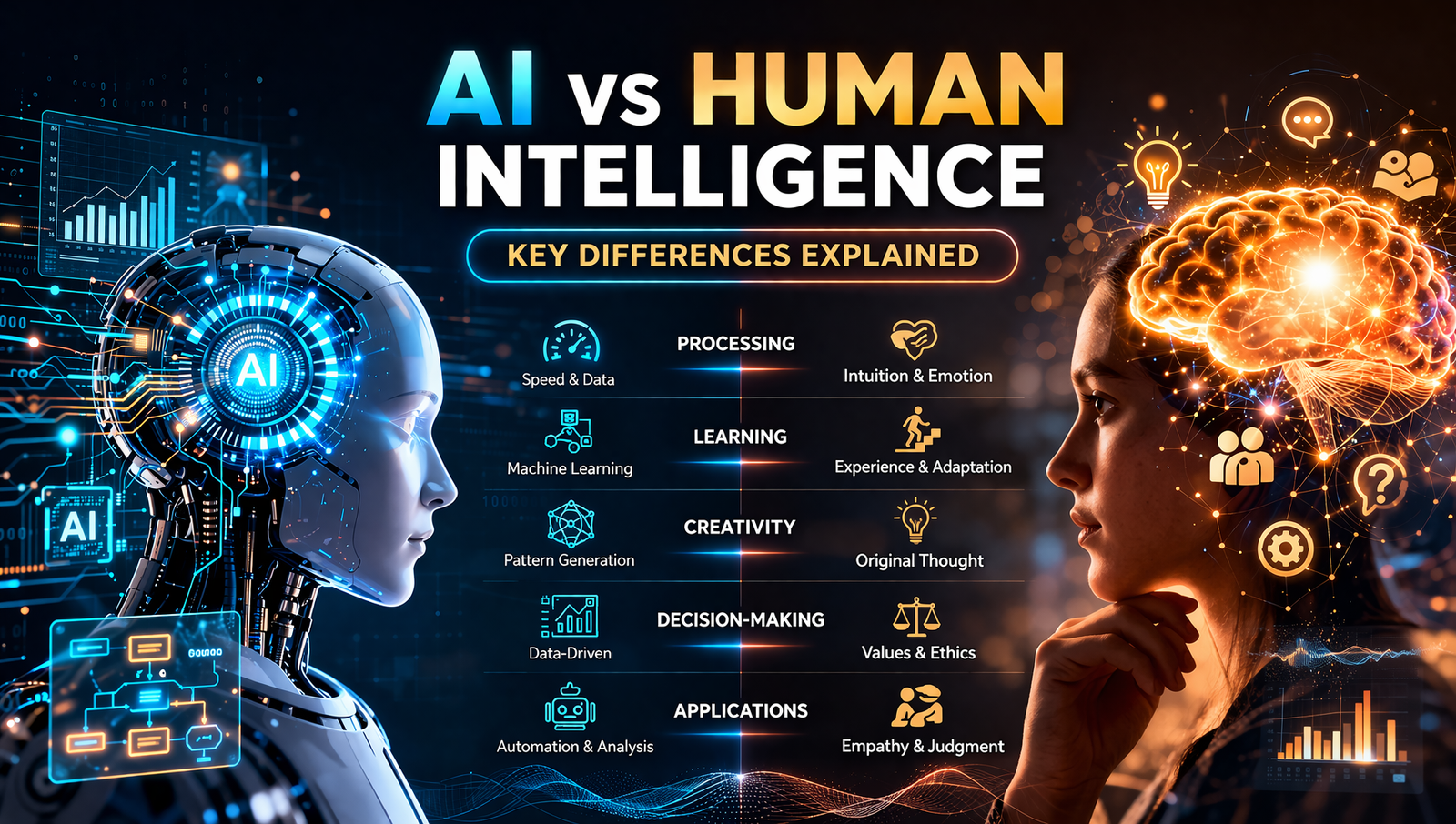
I was in a coffee shop last week when I overheard something that stopped me mid-sip. Two students at the next table were debating whether their professor could tell if they’d used ChatGPT for their essays. One argued confidently that “AI is basically as smart as humans now.” The other countered that “AI doesn’t actually think—it just predicts words.”
They were both half right. And that’s the problem with how most of us think about AI vs human intelligence.
We swing between two extremes. On one side, we marvel at AI passing bar exams, generating poetry, and diagnosing diseases—and conclude it must be conscious. On the other, we point to its obvious failures—hallucinations, lack of common sense, inability to understand context—and dismiss it as a sophisticated parrot.
The truth, as usual, lies somewhere in the middle. And understanding that middle ground matters more than ever.
As artificial intelligence vs human intelligence becomes a defining conversation of our era, we need clarity. Not hype. Not fear. Not dismissal. Just clear-eyed understanding of what each form of intelligence does well, where each falls short, and how they complement each other.
This guide explores the key differences between AI and human intelligence—how they learn, how they reason, where they excel, and where they stumble. By the end, you’ll have a framework for thinking about this relationship that’s useful whether you’re a student, professional, or just someone trying to make sense of a rapidly changing world.
Let’s dive in.
Part 1: What We Mean by Intelligence
Before comparing AI vs human intelligence, we need to define our terms. Both words carry baggage.
Human Intelligence
Human intelligence isn’t a single thing. It’s a constellation of capacities:
- Reasoning: The ability to think logically, draw conclusions from premises, and solve problems
- Learning: Acquiring knowledge and skills through experience, study, or teaching
- Memory: Storing and retrieving information
- Creativity: Generating novel ideas or solutions
- Emotional understanding: Perceiving, interpreting, and responding to emotions
- Self-awareness: Consciousness of one’s own thoughts and existence
- Common sense: Intuitive understanding of how the world works
Psychologists debate exactly how to measure or categorize these abilities, but most agree that human intelligence is multifaceted, context-dependent, and deeply intertwined with consciousness and experience .
Artificial Intelligence
AI refers to machines designed to perform tasks that typically require human intelligence. But “AI” covers a vast spectrum:
- Narrow AI: Systems designed for specific tasks (face recognition, language translation, chess). Today’s AI is almost entirely narrow.
- General AI: Hypothetical systems that match human versatility across domains. We’re nowhere near this.
- Superintelligence: Theoretical systems exceeding human capabilities in virtually everything. Pure speculation.
When people debate AI vs human intelligence, they’re usually comparing narrow AI (what exists) to general human intelligence (what we have). That’s like comparing a calculator to a mathematician—useful for specific tasks, but not a meaningful contest of overall ability.
Part 2: How They Learn
One of the most fundamental differences between AI and human intelligence lies in how they acquire knowledge.
Human Learning
Humans learn through experience, observation, instruction, and exploration. A child learns what a cat is by seeing cats, hearing the word, maybe petting one, and gradually building a mental model that distinguishes cats from dogs.
Key characteristics of human learning:
- Data-efficient: A child might need to see only a few examples to grasp a concept
- Multimodal: We integrate sight, sound, touch, and context
- Social: Much human learning happens through interaction with others
- Continuous: We learn throughout life, building on existing knowledge
- Transferable: Concepts learned in one domain apply to others
AI Learning
Most modern AI learns through training on massive datasets. A language model like GPT-4 was trained on hundreds of billions of words—more text than a human could read in several lifetimes. From this, it extracts statistical patterns: which words tend to follow which, what topics cluster together, how language is structured.
Key characteristics of AI learning:
- Data-hungry: Requires enormous datasets to perform well
- Statistically driven: Finds patterns, doesn’t understand meaning
- Brittle: Knowledge doesn’t easily transfer to new domains
- Fixed after training: Most models don’t learn continuously
- Opaque: Even engineers often can’t explain exactly what the model learned
The Crucial Difference
Humans learn meaning. AI learns correlation.
When a human learns about cats, they understand that cats are living beings with feelings, that they might scratch if frightened, that they land on their feet. When AI “learns” about cats, it learns that the word “cat” often appears near “feline,” “whiskers,” and “pet” in its training data. It has no concept of what a cat actually is .
This matters because humans can reason about novel situations involving cats. AI can only apply patterns from its training data. If you describe a purple cat that speaks French, a human might find that amusingly absurd. AI might generate a sentence about purple French-speaking cats without any sense that it’s describing something impossible.
Part 3: How They Reason
Reasoning is another domain where AI vs human intelligence reveals stark differences.
Human Reasoning
Humans reason in multiple ways:
- Deductive reasoning: Drawing specific conclusions from general principles (all humans are mortal; Socrates is human; therefore Socrates is mortal)
- Inductive reasoning: Generalizing from specific observations (every swan I’ve seen is white; therefore all swans are probably white)
- Abductive reasoning: Inferring the most likely explanation (the grass is wet; it rained last night; therefore rain is the likely cause)
- Analogical reasoning: Applying knowledge from familiar domains to unfamiliar ones
Crucially, human reasoning is integrated with experience, emotion, and context. We don’t just process logic—we interpret situations, weigh competing considerations, and make judgments that aren’t purely computational.
AI Reasoning
AI reasons statistically. When you ask a language model a question, it doesn’t logically derive an answer. It calculates the most probable sequence of words given its training data and your prompt.
This leads to some impressive results—AI can solve complex math problems, write code, and answer factual questions. But it also leads to characteristic failures:
- Hallucinations: AI confidently states false information because it’s statistically plausible
- Brittleness: Minor changes in phrasing can produce wildly different answers
- Lack of consistency: AI might give contradictory responses to the same question asked differently
- No self-correction: Without explicit prompting, AI doesn’t recognize or fix its own errors
Example That Illustrates the Difference
Ask a human: “If you drop a feather and a hammer on the moon, which hits first?”
Most humans who know basic physics will say they hit simultaneously—because they understand the principle that without air resistance, all objects accelerate at the same rate regardless of mass.
Ask an AI. It will likely give the correct answer—because that fact appears in its training data. But ask a follow-up: “Why?” It will explain the physics. Ask a variation: “What about on Mars?” It will adjust for Mars’s atmosphere. All correct.
But now ask: “If you drop a feather and a hammer on a planet where the air is made of molasses, which hits first?” A human might pause, think, and reason that the extreme air resistance would affect the feather much more—so the hammer hits first. An AI, unless it’s seen this exact scenario in training, will likely default to the physics principle it “knows,” producing a confidently wrong answer .
This isn’t a knock on AI—it’s just a different kind of intelligence. AI knows what it was trained on. Humans can reason beyond their experience.
Part 4: Strengths Comparison
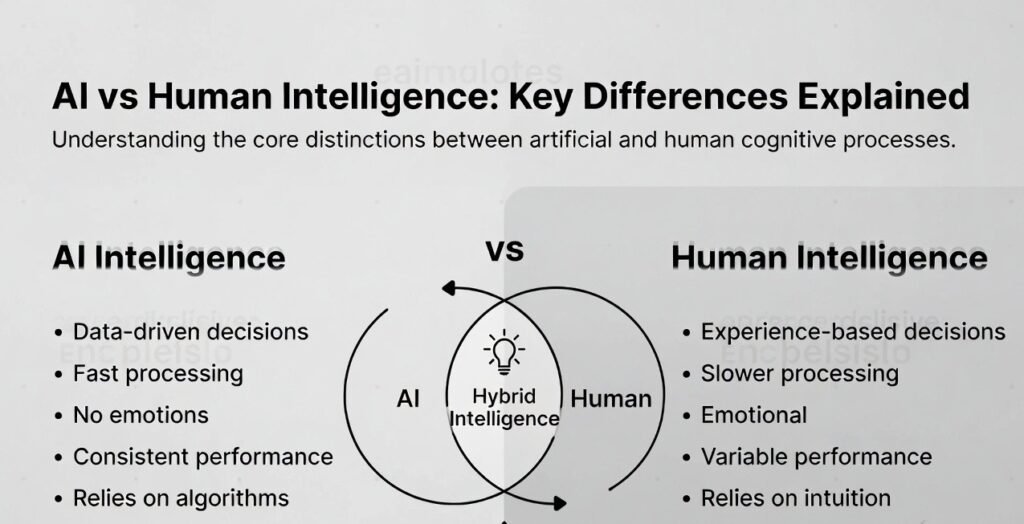
Let’s put AI vs human intelligence side by side.
| Domain | AI Strength | Human Strength |
|---|---|---|
| Speed | Processes vast data in seconds | Slow, deliberate |
| Scale | Handles millions of tasks simultaneously | Single-threaded attention |
| Consistency | Never tires, always follows rules | Variable, subject to fatigue and emotion |
| Memory | Perfect recall of training data | Fallible, reconstructive |
| Pattern recognition | Identifies subtle patterns in huge datasets | Good at patterns, limited by data volume |
| Creativity | Combines existing ideas in novel ways | Genuinely original insight |
| Context | Limited to statistical context | Deep understanding of situation and nuance |
| Emotional intelligence | Simulates understanding | Genuinely feels and responds |
| Common sense | Often absent or brittle | Robust, learned through experience |
| Adaptability | Brittle outside training distribution | Flexible across novel situations |
| Explainability | Often a “black box” | Can explain reasoning |
| Ethics | Follows programmed constraints | Moral reasoning based on values |
Where AI Excels
AI dominates in tasks requiring speed, scale, and pattern recognition across massive data:
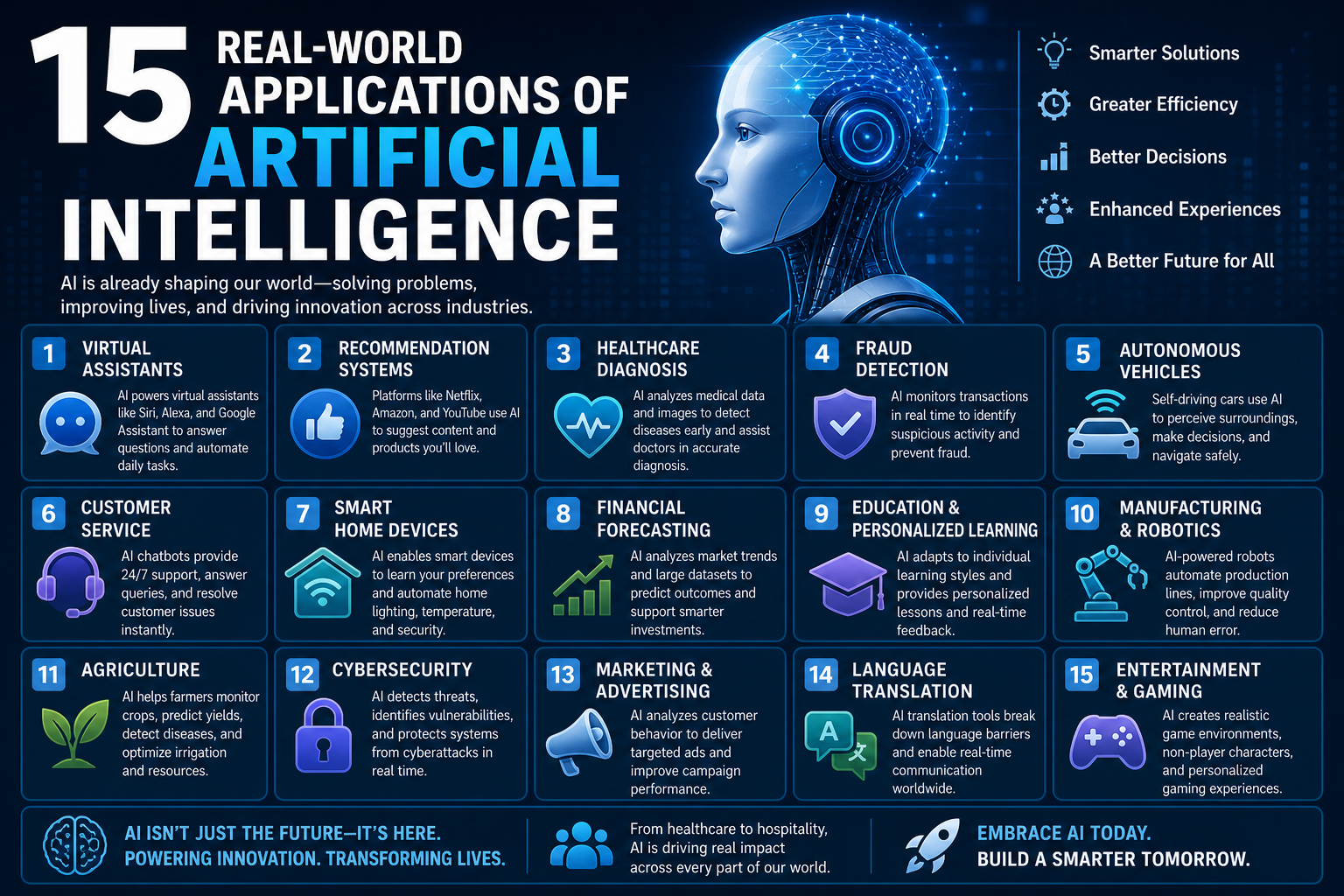
- Analyzing millions of medical images for anomalies
- Processing financial transactions for fraud detection
- Translating between languages at scale
- Summarizing vast document collections
- Predicting equipment failures from sensor data
Where Humans Excel
Humans dominate in tasks requiring context, creativity, emotional understanding, and ethical judgment:
- Leadership and inspiration
- Creative breakthrough in arts and science
- Counseling and therapy
- Negotiation and relationship-building
- Moral reasoning in complex situations
- Adapting to entirely novel circumstances
Part 5: Creativity Compared
The creativity question is one of the most debated in AI vs human intelligence.
AI Creativity
AI can generate impressive creative work. It writes poems in the style of Shakespeare, composes music mimicking Bach, creates visual art that wins competitions. In 2022, an AI-generated artwork won first place at the Colorado State Fair .
But what’s actually happening? AI doesn’t experience inspiration or have something to express. It identifies patterns in its training data—what words tend to appear together, what visual styles please humans—and recombines them in novel ways .
Think of it like this: AI is a brilliant mimic and combiner. Give it enough examples of sonnets, and it will generate text that looks like a sonnet. But it has no feelings to express, no experience of love or loss to draw on, no unique perspective on the world.
Human Creativity
Human creativity is rooted in experience, emotion, and intention. When Maya Angelou wrote poetry, she drew on her life—her pain, her joy, her observations. When Beethoven composed, he expressed something internal, something he needed to communicate.
Human creativity is also inherently social and contextual. We create for audiences, in response to cultural moments, to provoke reaction or convey meaning. Our creativity is inseparable from our humanity.
The Blurred Line
That said, the line is blurring. Some AI-generated art genuinely moves people. Some human-created work is derivative and formulaic. The difference may be less about the output and more about the process and intention behind it.
The philosopher’s question: if an AI generates a poem that makes you cry, does it matter that the AI felt nothing? The tears are real, even if the “artist” is a statistical model.
Part 6: Consciousness and Self-Awareness
This is where the comparison becomes philosophical.
Human Consciousness
Humans are conscious. We have subjective experience—there’s “something it’s like” to be us. We feel pain, pleasure, curiosity, boredom. We’re aware of ourselves as beings with pasts and futures.
This consciousness underpins much of what we value: love, meaning, purpose, connection. It’s why we care about each other, why injustice matters, why art moves us.
AI and Consciousness
No credible evidence suggests current AI systems are conscious. They process information, generate outputs, and simulate understanding—but there’s no reason to believe they experience anything.
When an AI says “I feel happy,” it’s generating a statistically appropriate response, not expressing an internal state. It has no internal state to express.
Whether AI could become conscious is a deep philosophical question. Some argue consciousness emerges from sufficient information processing; others believe it requires biological substrates we don’t understand. For now, the gap between AI and human experience remains vast.
Part 7: The Collaboration Opportunity
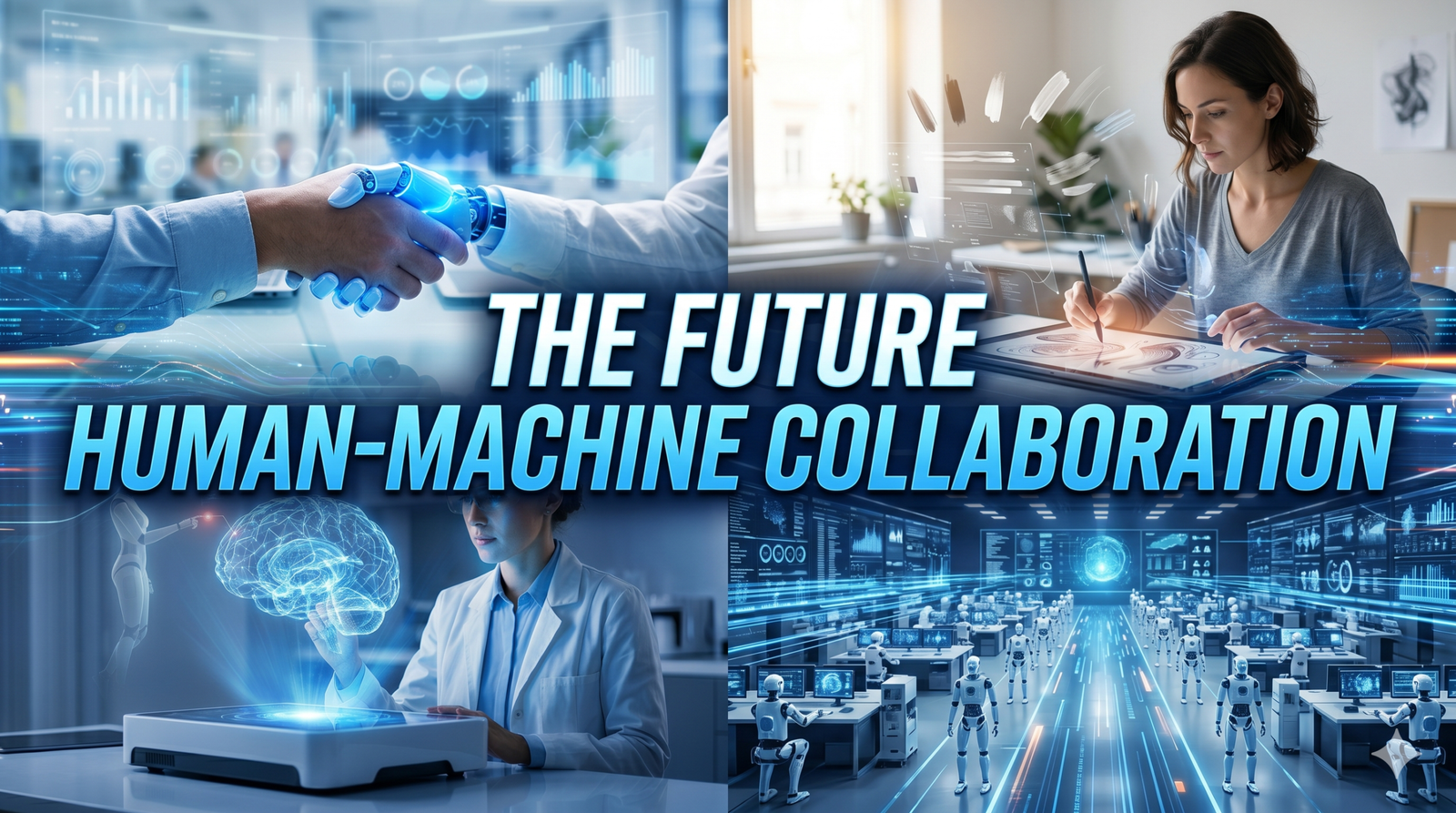
The most productive framing of AI vs human intelligence isn’t competition—it’s collaboration.
What AI Brings
AI offers scale, speed, and pattern recognition beyond human capability. It never tires, never gets bored, never has an off day. It processes millions of data points while you sleep.
What Humans Bring
Humans bring context, judgment, creativity, and ethical reasoning. We understand nuance, navigate ambiguity, and make value-based decisions. We care about outcomes in ways machines cannot.
The Combined Effect
Together, humans and AI outperform either alone. Studies in medical diagnosis show AI achieves about 50% accuracy, humans about 40%, and humans+AI about 60% . The combination beats both individual performances.
This pattern repeats across domains: AI suggests, humans decide. AI generates options, humans choose. AI handles scale, humans handle meaning.
Real-World Examples
- Healthcare: AI flags potential issues in scans; doctors interpret and decide treatment
- Law: AI reviews documents for relevance; lawyers build strategy and argue cases
- Education: AI tutors provide personalized practice; teachers inspire and mentor
- Creative work: AI generates drafts and variations; artists refine and infuse meaning
- Business: AI analyzes data and identifies patterns; leaders make strategic decisions
Part 8: Limitations and Risks
Understanding AI vs human intelligence also means understanding where each falls short.
AI Limitations
- Brittleness: AI fails in unexpected ways outside its training distribution
- Bias: AI learns biases present in training data, potentially amplifying discrimination
- Opacity: Many AI systems are black boxes—we can’t explain why they reached conclusions
- No common sense: AI lacks basic understanding of how the world works
- Hallucinations: AI confidently produces false information
- No values: AI doesn’t inherently care about truth, fairness, or human wellbeing
Human Limitations
- Scalability: Humans can’t process millions of data points
- Consistency: Humans tire, get distracted, make random errors
- Bias: Humans have their own prejudices and blind spots
- Memory: Human memory is reconstructive and fallible
- Speed: Humans are slow compared to machines
- Emotion: Emotions can cloud judgment (though they also enable wisdom)
The Risk of Misunderstanding
The greatest risk in the AI vs human intelligence conversation is misunderstanding what AI is and isn’t.
If we overestimate AI, we delegate decisions it shouldn’t make—medical diagnoses without oversight, criminal justice determinations without human review, ethical judgments beyond its capability.
If we underestimate AI, we miss opportunities to augment human capability—to diagnose disease earlier, to personalize education, to accelerate scientific discovery.
The right path is clear-eyed understanding: AI as powerful tool, not replacement; as collaborator, not competitor.
Part 9: The Future
Where is this heading?
Near-Term (Next 5 Years)
AI will become more capable, more integrated, more reliable. Hallucinations will decrease. Reasoning will improve. Specialized AIs will excel in narrow domains. Human-AI collaboration will become standard in knowledge work.
But the fundamental differences will remain. AI won’t gain consciousness, common sense, or genuine understanding. It will remain a statistical pattern-matching engine—just a much better one.
Medium-Term (5-15 Years)
Debates about AI consciousness may intensify if systems become sufficiently complex. Some will argue they’re sentient; others will disagree. Philosophical and legal frameworks will evolve.
AI may develop more robust reasoning and transfer learning—applying knowledge from one domain to another. But general intelligence matching human versatility remains distant.
Long-Term (15+ Years)
Speculation becomes unreliable. Some experts believe human-level AI is possible; others doubt it. If achieved, it would fundamentally reshape the AI vs human intelligence conversation—because we’d be comparing peers, not tools and users.
For now, that’s science fiction. Today’s AI is a tool—an extraordinary one, but a tool nonetheless.
Conclusion
Let’s bring this together.
The question of AI vs human intelligence isn’t a contest with a winner. It’s a comparison between fundamentally different kinds of intelligence, each with unique strengths and limitations.
Artificial intelligence excels at scale, speed, and pattern recognition. It processes vast data, identifies subtle correlations, and performs repetitive tasks without fatigue. It’s a tool of unprecedented power—but it’s still a tool. It doesn’t understand, doesn’t feel, doesn’t have common sense or genuine creativity.
Human intelligence excels at context, meaning, and judgment. We understand nuance, navigate ambiguity, and make value-based decisions. We create from experience, connect through empathy, and care about outcomes. We’re limited, fallible, and biased—but we’re also conscious, purposeful, and irreplaceable.
The future isn’t about one replacing the other. It’s about collaboration—AI handling what it does best, humans focusing on what only humans can do.
In healthcare, AI flags anomalies; doctors decide treatment. In education, AI tutors practice; teachers inspire. In business, AI analyzes data; leaders strategize. In creative work, AI generates options; artists infuse meaning.
The most important insight from comparing artificial intelligence vs human intelligence is this: they’re complementary, not competitive. Each makes the other more valuable. The question isn’t which is “better.” It’s how we combine them for outcomes neither could achieve alone.
That’s the conversation worth having. And it starts with clear-eyed understanding of what each form of intelligence truly is.




Leave a Reply